Cats
 Dogs
Can Kittens Drink Milk?
Kittens need their mother's milk or a kitten milk replacer, never cow's milk. A week-by-week chart of what kittens drink, from birth to weaning.


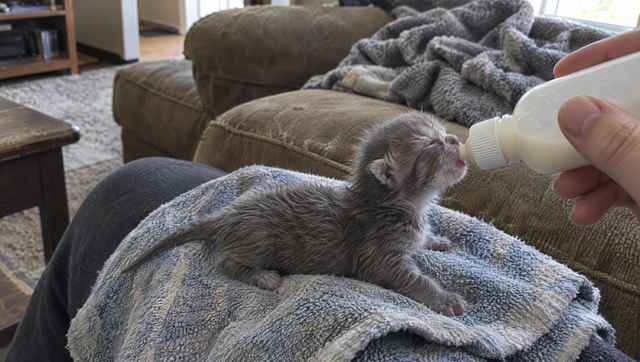
Can kittens drink milk? Yes, but only the right milk. The ASPCA says newborn kittens get complete nutrition from their mother's milk for the first four weeks.
When she isn't there, veterinary sources point to a commercial kitten milk replacer, never cow's milk from the fridge.
After weaning, which the ASPCA says is usually complete by eight to ten weeks, a kitten no longer needs milk at all. Fresh water and a complete kitten food take over.
Below is a chart of which milk fits which age, the reasons cow's milk is the wrong choice, and the signs that mean a call to your vet.
Can kittens drink cow's milk?
No. The ASPCA puts it plainly: do not use cow's milk, because it will cause stomach upset and diarrhea in some kittens. Plain cow's milk is the wrong drink for most cats at any age.
There are two reasons. The first is nutrition.
A review of orphaned kitten care by Dr. Susan Little in the Journal of Feline Medicine and Surgery notes that cow's milk is lower in protein and fat than a mother cat's milk, and is a poor source of taurine.
Today's Veterinary Nurse, a peer-reviewed veterinary nursing journal, adds that iron, copper and zinc are markedly higher in a mother cat's milk than in cow's milk.
The second reason is digestion. The ASPCA explains that cats do not have significant amounts of lactase, the enzyme that breaks down lactose (the sugar in milk). The ASPCA links milk to vomiting and diarrhea in cats.
Which milk is safe for a kitten?
Here is how the common options compare, using what the veterinary sources say about each one:
| Milk | For a nursing-age kitten? | What the sources say |
|---|---|---|
| Mother cat's milk | Yes, the first choice | The ASPCA calls it perfect for kittens' needs. Merck says the mother's milk is superior to any formula and should be used when available. |
| Commercial kitten milk replacer | Yes, when the mother isn't there | Merck says commercial formulas are superior to homemade versions. Little advises one that approximates a mother cat's milk. |
| Homemade formula | Emergency only | Little limits homemade recipes to short-term or emergency use. |
| Cow's milk | No | Lower in protein and fat, poor in taurine (Little); causes stomach upset and diarrhea in some kittens (ASPCA). |
| Goat's milk | No | Little's review finds it has no nutritional benefits compared with cow's milk. |
| Replacer made for puppies, calves or other species | No | The FDA urges extreme caution when using a milk replacer in a species it wasn't made for. |
Milks sold for adult cats sit outside this chart. None of the veterinary sources we used recommends them for a kitten that still needs milk. For that stage, every source points to a kitten milk replacer.
Why does a mother cat's milk matter so much?
The first milk a kitten drinks is special. It's called colostrum, and it carries antibodies from the mother. Little's review says kittens absorb nearly all of this borrowed immunity in the first 12 to 18 hours of life.
Today's Veterinary Nurse gives a slightly longer window, about 48 hours, before the gut closes to those antibodies. Either way, the window is short, and Little notes that kittens who miss colostrum are most vulnerable to infection from birth to about six weeks.
Here is the surprising part. A mother cat's milk changes as her kittens grow. Little reports that its energy, protein, lactose, calcium and phosphorus all rise as nursing goes on, matching a kitten whose needs climb week by week.
Little also notes there is no evidence that replacers advertised as containing colostrum give a kitten any immunity, which is one more reason a vet check matters for an orphaned kitten.
Can kittens drink milk at every age? A chart by week
The answer changes fast in the first two months. This chart combines the ASPCA's feeding milestones with Little's review. If you're not sure how old your kitten is, a kitten age chart can help you place her.
| Age | What a kitten drinks and eats |
|---|---|
| Birth to 3 weeks | Mother's milk only, or kitten milk replacer by bottle. The ASPCA says mom's milk is all she needs. |
| 3 to 4 weeks | Weaning can begin. Little suggests offering replacer from a shallow saucer. The ASPCA says hand-fed kittens can start at about three weeks. |
| 4 weeks | The ASPCA says weaning normally begins around now for kittens with their mother. |
| 5 to 6 weeks | The ASPCA says kittens should be nibbling dry kitten food consistently. Little says most can chew it by now. |
| 6 to 10 weeks | Weaning finishes. Little puts it at 6 to 9 weeks, the ASPCA at 8 to 10. |
| After weaning | Kitten food and fresh water. The ASPCA says milk should not be fed to cats as a substitute for water. |
The two sources disagree by a week or two on when weaning ends. Today's Veterinary Nurse advises letting each kitten set the pace, since some aren't ready at three to four weeks. Your vet can tell you whether yours is ready to stop.
How much milk replacer does a young kitten need?
Start with the label on the replacer you buy. The FDA says using a milk replacer successfully depends on following the label directions and keeping everything clean, and that a product mixed incorrectly can make an animal seriously ill.
For timing, Little's review advises feeds every 2 to 4 hours in the first week, then every 4 to 6 hours until weaning. She puts a kitten's daily energy needs at 15 to 25 kcal for every 100 g of body weight.
A fact worth picturing: Little gives a kitten's stomach capacity as about 4 to 5 mL per 100 g of body weight. By our arithmetic, a 100 g newborn holds roughly a teaspoon per feed.
For the full method, from warming the bottle to weighing her each day, see our guide to kitten milk replacer.
Does a weaned kitten still need milk?
No. Once weaning is done, the ASPCA's guidance is that milk should not be fed to cats as a treat or a substitute for water. It warns that milk and milk-based products can cause cats to vomit or have diarrhea.
What she needs instead is a complete kitten food. The ASPCA says kittens need kitten-formula food until they reach maturity, at about one year. Our guide to kitten food covers how much and how often.
If you're wondering about milk for her later in life, our article on cat milk covers what the research says for adult cats.
Call your vet promptly if a kitten on milk or replacer:
- has diarrhea. Little calls it a common problem in kittens fed replacer, often from over-feeding or an unsuitable formula, and Merck describes yellow, curdled stool from too much formula
- isn't gaining weight. Merck expects kittens to gain 50 to 100 g a week
- cries a lot, is restless or seems floppy, which Little says should be examined promptly
- feels cold, or won't suck
- has dark yellow urine, which Little notes may point to dehydration
Questions new kitten parents ask
Can a 2-week-old kitten drink cow's milk?
No. At two weeks a kitten needs her mother or a kitten milk replacer. The ASPCA warns that cow's milk causes stomach upset and diarrhea in some kittens.
Can kittens drink goat milk?
Little's review finds goat's milk has no nutritional benefits compared with cow's milk, so it can't stand in for a kitten milk replacer.
Can kittens drink lactose-free milk?
Removing lactose deals with the digestion problem only. By our reading of Little's review, it leaves the lower protein, fat and taurine of cow's milk unchanged, so a kitten replacer is still the right choice before weaning.
When do kittens stop drinking milk?
When weaning is done: 6 to 9 weeks in Little's review, 8 to 10 weeks according to the ASPCA. After that, water and kitten food.
What can I give a kitten if I have no replacer tonight?
Call your vet or a local emergency clinic for advice. Little limits homemade formulas to short-term or emergency use, and Merck says commercial replacers are superior.
Sources
- Little S. Playing Mum: Successful management of orphaned kittens. Journal of Feline Medicine and Surgery, 2013
- ASPCA: Cat Nutrition Tips
- Merck Veterinary Manual: Management of the Neonate in Dogs and Cats
- Wortinger A, Carozza EM. Feeding Orphaned Kittens From Birth Through Weaning. Today's Veterinary Nurse, 2024
- FDA Center for Veterinary Medicine: Storing, Handling and Using Animal Milk Replacer Products
This article is for general information and is not veterinary advice. Talk to your vet about your own cat — they know the animal in front of them.
Choolip products are food supplements, not medicine. They are not intended to diagnose or manage any medical condition. If your cat has been diagnosed with a condition, their diet should be set by your vet.
Try a Little of Everything First
The Trial Box has a Variety Pouch, a Jumbo stick and two Berry Good Milks. Subscribe & Save, $22.00 a box.