Cats
 Dogs
Found a Kitten? What to Do First
Found a kitten outside? How to tell if the mother is coming back, how old the kitten is, why warmth comes before food, and what the first vet visit covers.


If you found a kitten, the ASPCA's advice is to leave it where it is and check back over a few hours, because the mother may be nearby getting food or waiting for you to leave.
The ASPCA adds that ill or injured kittens should go to a shelter, rescue or vet as soon as possible.
For a kitten you do take in, veterinary sources advise warming it slowly before any feeding, and using kitten milk replacer rather than cow's milk. Then ask a vet to check it.
Is the mother cat coming back?
She may be. The ASPCA notes that the mother "could be nearby getting food (or hiding from you)," and recommends leaving the kittens where they are and checking periodically to see if she returns in a few hours.
The ASPCA adds that she may have started moving her kittens somewhere else by the time you come back.
The ASPCA says kittens a mother is caring for tend to be clean, plump and quiet. Kittens that are dirty, skinny and crying excessively might be orphaned.
If the spot is unsafe, such as a road edge or a storm drain, the ASPCA suggests moving the kittens to a safe place nearby where the mother can still find them.
When to step in right away
- The kitten looks sick or injured. The ASPCA says to call ahead and take it to a shelter, rescue or vet as soon as possible.
- A few hours have passed, and the mother hasn't come back.
- The kittens are dirty, thin and crying without stopping.
How old is the kitten you found?
Age shapes the care a kitten needs, including how warm it should be kept and what it eats. These milestones come from a review of orphaned-kitten care in the Journal of Feline Medicine and Surgery, with the last two from the ASPCA.
| What you see | Typical age |
|---|---|
| Umbilical cord still attached | Under about 3 days |
| Eyes closed | Under about 7–10 days |
| Ear canals open | Around 9 days |
| Starting to walk, wobbly | About 2–3 weeks |
| First baby teeth (front teeth and fangs) | About 3–4 weeks |
| Eating wet food alone | About 4–5 weeks (ASPCA) |
| About two pounds, eating on its own | About 8 weeks (ASPCA) |
A newborn is tiny. The same review puts average birth weight at about 100 g, less than a quarter of a pound. Our guide to how old is my kitten walks through each week with photos of what to look for.
Why does warmth come before food?
The Merck Veterinary Manual states that kittens lack the ability to regulate their own body temperature until 4 weeks of age, so they rely on an outside heat source.
Little's review explains the reason for warming before feeding: hypothermia causes ileus (the gut stops moving) and increases the risk of aspiration pneumonia, when food is breathed into the lungs. It advises rewarming slowly before feeding.
Merck advises rewarming over 30 to 60 minutes, to avoid problems with blood flow and dehydration. Little suggests a hot water bottle wrapped in a clean towel, and says heating pads heat unevenly and may cause burns.
Little also advises a temperature gradient, so the kitten can move away from the heat. Merck's guide for the nest itself:
- Week 1: 84–89°F
- Weeks 2–3: about 80°F
- Week 4: 69–75°F
What do I feed a found kitten?
Little's review recommends kitten milk replacer. It explains that cow's milk is "lower in protein and fat than queen's milk, and is a poor source of taurine," a nutrient cats need.
The same review says goat's milk has no nutritional benefits compared with cow's milk.
Bottle-feeding has its own technique. Our kitten milk replacer guide covers how much to give, how to hold the kitten, and when weaning begins.
The ASPCA says kittens are able to eat wet food on their own at around 4 to 5 weeks. Little's review describes weaning from about 3 to 4 weeks, starting with milk replacer in a shallow saucer, then canned kitten food mixed with formula.
The step that's easy to miss
Little's review states that orphans younger than 3 weeks "must have the anogenital area stimulated after every feeding" to make them pee and poop. In a litter, the mother does this by licking. Ask your vet to show you how.
When should a found kitten see a vet?
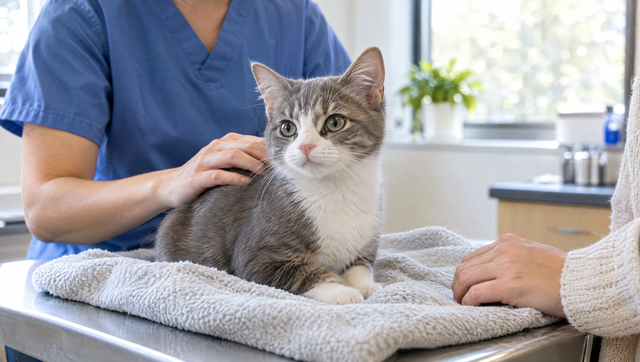
Cornell's Feline Health Center says any new cat should be checked by a veterinarian as soon as possible after coming home.
Here's what Cornell and other sources describe for that first visit:
- A microchip scan. The ASPCA recommends checking for a chip or ID before assuming a cat has no home.
- Tests for feline leukemia virus (FeLV) and feline immunodeficiency virus (FIV), which Cornell recommends for any cat with an unknown history.
- A check for fleas, ticks, mites and intestinal worms, as Cornell describes. The Companion Animal Parasite Council advises deworming kittens from 2 weeks of age, repeated every 2 weeks.
- A vaccine plan. Cornell notes the first FVRCP shot is given at six to eight weeks.
If you have other cats, Cornell advises keeping the newcomer separate until your vet has examined it. When the time comes, our guide on how to introduce cats covers the first meeting.
Call your vet promptly if the kitten:
Little's review says kittens that cry excessively, are restless or have poor muscle tone should be examined by a vet promptly, because a young kitten's condition can deteriorate rapidly. Merck lists these among signs that may indicate sepsis, a serious body-wide infection:
- failure to suckle
- a drop in weight gain. Merck expects kittens to gain about 50–100 g a week
- persistent diarrhea
- unusual crying
- blood in the urine
- a swollen or painful belly
Can you keep a kitten you found?
The ASPCA advises first making sure the kitten doesn't already have an owner, by checking for an ID tag and asking a shelter, rescue or vet clinic to scan for a microchip.
The AAHA/AAFP Feline Life Stage Guidelines put the sensitive window for getting used to people and new things at roughly 2–3 weeks to 9–10 weeks old. The guidelines stress that the quality of each experience is what matters most, so keep handling gentle and positive.
The guidelines also note that orphaned kittens may have behavior concerns. Ask your vet how to handle and socialize the kitten you found.
If you can't keep the kitten, the ASPCA suggests contacting a shelter or rescue, and calling first to make sure they can accept kittens.
The ASPCA lists spay or neuter surgery as part of the medical care a foster kitten needs. Our guide on when to spay a cat covers the timing.
Questions people ask when they find a kitten
What do I do if I find a kitten with no mother?
The ASPCA advises leaving the kitten in place and checking back over a few hours to see if the mother returns. If she doesn't, veterinary sources advise warming the kitten before feeding kitten milk replacer, then calling a vet.
Can I give a found kitten cow's milk?
A review in the Journal of Feline Medicine and Surgery advises against it: cow's milk is lower in protein and fat than a mother cat's milk and a poor source of taurine. It recommends kitten milk replacer.
Should I feed a cold kitten?
Merck and Little both advise rewarming first, slowly, over 30 to 60 minutes. Little explains that a chilled kitten's gut stops moving, which raises the risk of aspiration pneumonia.
Will the mother reject a kitten I've touched?
The ASPCA's guidance doesn't address touching. It advises giving the mother a few hours to return, and if you move kittens for safety, keeping them nearby where she can still find them.
How soon should a found kitten see a vet?
Cornell advises a vet check for any new cat as soon as possible after it comes home. The ASPCA says an ill or injured kitten should be seen as soon as possible.
Sources
- ASPCA: I Found Kittens Outside, What Do I Do?
- Little S. Playing Mum: Successful management of orphaned kittens. Journal of Feline Medicine and Surgery, 2013
- Merck Veterinary Manual: Management of the Neonate in Dogs and Cats
- Cornell Feline Health Center: Choosing and Caring for Your New Cat
- Companion Animal Parasite Council: General Guidelines
- Quimby J, et al. 2021 AAHA/AAFP Feline Life Stage Guidelines. Journal of the American Animal Hospital Association, 2021
This article is for general information and is not veterinary advice. Talk to your vet about your own cat — they know the animal in front of them.
Choolip products are food supplements, not medicine. They are not intended to diagnose or manage any medical condition. If your cat has been diagnosed with a condition, their diet should be set by your vet.
Try a Little of Everything First
The Trial Box has a Variety Pouch, two Total Balance Jumbo sticks and two Berry Good Milks. One box, $22.