Cats
Cats Dogs
DogsHow Much Water Do Cats and Dogs Need a Day?
Daily water needs for dogs and cats by weight, how much of it comes from food, how to measure what your pet drinks, and when drinking too much or too little needs a vet.


How much water should a dog drink? About two-thirds of an ounce to an ounce per pound of body weight a day, counting the water in food. Cats need roughly a cup a day for a 10-pound cat.
Healthy dogs and cats are good at judging their own needs, as long as clean water is always there. What's worth knowing is the normal range for your pet, so you'll notice if it changes.
How much water should a dog drink a day?
The Merck Veterinary Manual calls water the most important nutrient. Merck puts most mammals' daily need at about 44 to 66 mL per kg of body weight, at a comfortable room temperature.
Here is that range worked out for dogs of a few sizes. The totals include the water in food, so a dog on wet food will drink less from the bowl:
| Dog's weight | Water a day, all sources |
|---|---|
| 10 lb | About 200–300 mL (¾ to 1¼ cups) |
| 25 lb | About 500–750 mL (2 to 3 cups) |
| 50 lb | About 1–1.5 liters (4 to 6 cups) |
| 80 lb | About 1.6–2.4 liters (7 to 10 cups) |
Real dogs land close to that. A 2018 study in Frontiers in Veterinary Science measured healthy adult dogs on dry food and found they took in about 71 mL per kg a day in total, in line with earlier reports of 63 to 73.
A handy rule: about a milliliter per calorie
Here's a neat way to think about it. The same paper notes that the National Research Council's conservative estimate of a dog's minimum need is about 1 mL of water for every calorie eaten.
The dogs in that study actually drank a little more, 1.2 to 1.4 mL per calorie. So a dog who burns more calories, on a busy day or a long hike, needs more water to match.
The researchers are honest about the limits. They write that daily water needs in healthy dogs are not well defined. Treat these numbers as a guide, and your own dog's normal as the real baseline.
How much water should a cat drink?
The Cornell Feline Health Center's guideline is about 4 ounces of water per 5 pounds of lean body weight per day. For an average 10-pound cat, that's about one cup.
| Cat's lean weight | Water a day, all sources |
|---|---|
| 5 lb | About 4 oz (½ cup) |
| 10 lb | About 8 oz (1 cup) |
| 15 lb | About 12 oz (1½ cups) |
Pound for pound, that's close to the dog figure. The difference is in the habit. Merck notes that cats often do not drink a lot of water, which is why where and how you offer it matters more for them.
Merck adds that multiple water sources encourage drinking, and that's especially true for cats. Our guide on how to get a cat to drink more water covers bowl placement and other tricks.
Many people try a fountain. The research there is more mixed than the marketing, and our look at whether cat water fountains work explains what the studies found.
Does the water in food count?
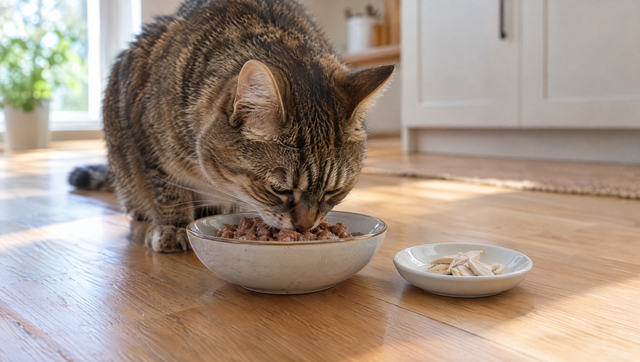
Yes, and it can be most of the total. Merck gives canned pet food a moisture content of 60% to more than 87%. Dry food holds just 3% to 11% water.
That's why, in Merck's words, dogs and cats eating mostly canned food generally drink less water than those eating dry food. Cornell says the same for cats: wet food can be up to 80% water.
So a pet on wet food who rarely visits the bowl may be doing perfectly well. A pet on kibble gets almost all of its water by drinking, so that bowl matters more.
Our guide on how to keep a dog hydrated covers bowls, travel and exercise.
What about milk and other drinks?
Water should stay the everyday drink. Anything else is an occasional extra that adds a little fluid, and any drink with calories counts toward the less-than-10% of daily calories that Merck allows for extras.
Plain cow's milk isn't a good fit for many pets. Our guides to can cats drink milk and can dogs drink milk explain why, and how much is sensible.
One option made for pets is Choolip's Berry Good Milk, a ready-to-drink, lactose-free Grade A cow's milk for cats and dogs, with added lactase. It provides taurine, calcium, vitamins D3 and E, omega-3 (DHA and EPA), CoQ10, glucosamine and cranberry extract.
It's optional, and a pet with fresh water and a complete food doesn't need it. It isn't a milk replacer either, so it's not for newborn kittens or puppies.
What changes how much they need?
Merck lists four things: diet, environment, activity level and health. Two of them you'll see every week.
- Heat and humidity. The ASPCA advises giving pets plenty of fresh, clean water when it's hot or humid outdoors, along with shade.
- Exercise. More activity burns more calories, and by the milliliter-per-calorie rule, more calories means more water.
- Diet. A switch from wet food to dry, or the reverse, will change how often your pet visits the bowl.
The good news is that you don't have to calculate any of this day to day. Merck states that healthy animals given plenty of water regulate their own intake well, and that water generally should not be restricted.
Your part is to keep it clean, fresh and easy to reach, in more than one spot. The ASPCA notes that water makes up 60 to 70% of an adult pet's body weight, so it's worth the small daily effort.
It also helps to know your own pet's normal. That way, a change stands out.
How much is too much, or too little?
There's a wide band of normal. A 2026 review in the Journal of Small Animal Practice reports that healthy laboratory dogs have been recorded drinking anywhere from 4 to 109 mL per kg a day.
The same review gives the usual definition of drinking too much in dogs: more than 90 to 100 mL per kg a day. For a 50-pound dog, that's more than about 2 liters, or 8 to 9 cups, day after day.
The number isn't the whole story. One study cited in the review put the upper limit of normal nearer 70 mL per kg. A dog who has always been a light drinker can be drinking much more than usual and still sit below 100.
So a lasting change from your pet's own normal is the thing to watch. Drinking far more than usual can be an early sign of a health problem, and your vet will usually start with a simple urine test.
How do I measure what my pet drinks?
The review notes that vets sometimes ask owners to measure water intake at home over several days. It's easy to do:
- Use one bowl, and pick up any others for the test.
- Fill it with a measured amount each morning.
- Twenty-four hours later, measure what's left and subtract.
- Repeat for a few days and take the average. Note any spills, other pets sharing the bowl, and wet food meals.
And too little?
Too little matters as much. The ASPCA warns that a 10% decrease in body water can cause serious illness, while a 15% loss can result in death.
Cornell lists the signs of a cat running short of water: lethargy, weakness, poor appetite, dry gums, and in more severe cases, eyes that look sunken. Cornell advises contacting a vet promptly if you're concerned.
Call your vet promptly if your dog or cat:
- is drinking clearly more than usual for more than a day or two, or you measure more than about 90 mL per kg a day in a dog
- is peeing much more, or having accidents in the house
- stops drinking, or drinks far less than normal
- seems weak or listless, or has dry gums or sunken-looking eyes
- pants heavily, drools or seems weak after time in the heat
Questions new cat and dog parents ask
Should I leave water out for my dog all day?
Yes. Merck and the ASPCA both say fresh, clean water should be available at all times, and Merck advises against restricting water for a healthy animal.
How much water should a puppy drink?
Puppies need water available at all times, like adult dogs. Their needs change quickly as they grow, so ask your vet what's normal for your puppy's size and food.
How much water should a cat drink a day?
About 4 ounces per 5 pounds of lean body weight, per Cornell, or one cup for a 10-pound cat. That total includes the water in food.
Why does my dog drink so much water after a walk?
Exercise burns calories and raises water needs, so a big drink afterward is normal. A rise in drinking that lasts for days without a clear reason is worth a call to your vet.
Sources
- Merck Veterinary Manual: Nutritional Requirements of Small Animals
- Merck Veterinary Manual: Feeding Practices in Small Animals
- Cornell Feline Health Center: Hydration
- Zanghi BM, Gerheart L, Gardner CL. Total Water Intake and Urine Measures of Hydration in Adult Dogs Drinking Tap Water or a Nutrient-Enriched Water. Frontiers in Veterinary Science, 2018
- Pavlovsky G. Psychogenic polydipsia in dogs: a review of pathogenesis, diagnosis and treatment. Journal of Small Animal Practice, 2026
- ASPCA: Dog Nutrition Tips
- ASPCA: Hot Weather Safety Tips
This article is for general information and is not veterinary advice. Talk to your vet about your own pet — they know the animal in front of them.
Try a Little of Everything First
The Trial Box has a Variety Pouch, a Jumbo stick and two Berry Good Milks. Subscribe & Save, $22.00 a box.