Cats
 Dogs
Kitten Weight Chart: How Much Should My Kitten Weigh?
Kittens start near 100 g and gain roughly a pound a month. This chart shows expected weight by week and month, how often to weigh, and when to call your vet.


A kitten weight chart starts at about 100 g (3.5 oz) at birth. From there, a common guideline is roughly 1 pound of weight for each month of age, so about 2 lb at 2 months and 4 lb at 4 months.
A 2020 study in the Journal of Feline Medicine and Surgery tested that rule and found it holds up well through about 10 weeks. After that, kittens spread out, and the trend on your own scale matters more than any single number.
Kitten weight chart: the first four weeks
Dr. Susan Little's veterinary review of kitten rearing puts normal birth weight at 90 to 110 g for domestic shorthair and longhair kittens, and normal gain at 10 to 15 g a day while kittens are on milk.
We used those two figures to estimate the range week by week. These are our arithmetic, not measured averages:
| Age | Estimated weight (grams) | Estimated weight (ounces) |
|---|---|---|
| Birth | 90–110 g | 3.2–3.9 oz |
| 1 week | 160–215 g | 5.6–7.6 oz |
| 2 weeks | 230–320 g | 8.1–11.3 oz |
| 3 weeks | 300–425 g | 10.6–15.0 oz |
| 4 weeks | 370–530 g | 13.1–18.7 oz |
The Merck Veterinary Manual gives a slightly wider range for newborn kittens: a gain of 50 to 100 g a week. So a kitten a little under the lower figures in the table may still be doing fine. Ask your vet if you are unsure.
Breed matters from day one. Little notes that pedigree kittens vary a lot at birth, from about 73 g for a Korat to 116 g or more for a Maine Coon.
How much should my kitten weigh by month?
After weaning, Little's review says kittens should keep gaining about 100 g a week until 5 months of age.
By our arithmetic, that is about 430 g a month, or just under a pound, which is where the "pound a month" guideline comes from in practice.
| Age | Guideline weight | How often the 1 lb rule was within a week of true age (DiGangi 2020) |
|---|---|---|
| 4 weeks | About 1 lb (450 g) | 95% of colony kittens |
| 8 weeks | About 2 lb (0.9 kg) | 78% of colony kittens, 68% of pet kittens |
| 12 weeks | About 3 lb (1.4 kg) | 47% of pet kittens |
| 16 weeks | About 4 lb (1.8 kg) | 28% of pet kittens |
| 20 weeks | About 5 lb (2.3 kg) | 18% of pet kittens |
The DiGangi study compared kittens' weights with their known birth dates. Colony kittens were weighed repeatedly from birth to 8 weeks. Pet kittens aged 6 to 20 weeks were weighed once, when they came in for spay or neuter surgery.
Its conclusion: weight was an effective way to predict age through 10 weeks, and other clues should be used after that. Our guide to how old is my kitten covers the teeth and eye milestones vets use.
What happens after 5 months?
Growth slows and kittens begin to differ more by sex and build. Little notes that male kittens become larger than females.
The most detailed growth charts for this stage come from a 2022 study in PLOS ONE.
Its authors built growth curves from more than 14,000 weight records of about 7,000 healthy kittens seen at US primary care vet hospitals, covering 8 to 78 weeks of age.
In the UK research colony the authors used for comparison, males leveled off at about 10 months. Merck treats kittens as reaching adulthood at about 9 to 12 months.
Why the curve matters more than the number
The same PLOS ONE study tracked which kittens stayed near their starting line on the chart. About half of the research colony kittens (49%) stayed within two centile lines of where they started.
Among kittens that became overweight, 52% had crossed two or more centile lines upward. The authors present the charts as an aid to vets' decisions, not a diagnosis, so share your kitten's weights with your vet at each visit.
How often should I weigh my kitten?
For newborns, more often than you might think. Little's review advises weighing:
- Every 12 hours for the first 2 weeks of life.
- Every 24 hours until weaned.
- Once or twice a week until about 8 weeks, to make sure nutrition is keeping up with growth.
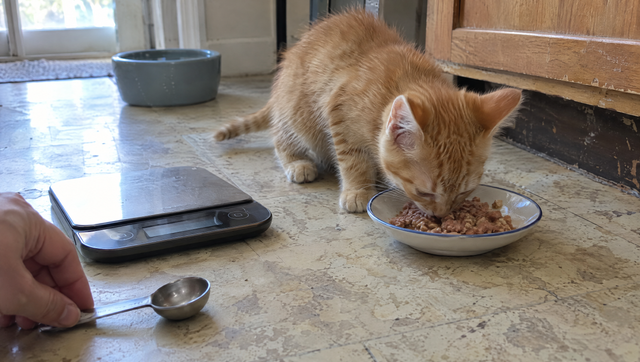
Merck's schedule is a little lighter: daily for the first 2 weeks, then every 3 days until 1 month old. Use a kitchen scale that reads in grams, since the daily changes are small.
Don't panic over the first day. Merck says a mild loss of up to 10% of birth weight is acceptable on day one, before steady gain begins.
For an orphaned kitten, our kitten milk replacer guide explains how feeding amounts tie to weight gain.
What if my kitten is gaining too slowly or too fast?
Feeding is the first thing to look at. Little advises adjusting the amount of milk replacer to reach normal gain of 10 to 15 g a day in kittens still on milk.
For weaned kittens, Cornell's Feline Health Center says kittens need more food per pound of body weight than adult cats, and usually do best on three meals a day until six months.
Our guide on how much to feed a kitten has the amounts by age, and when can kittens eat dry food covers the move to solid food.
Cornell also cautions that free feeding suits some cats but leads others to overeat and gain too much weight.
Call your vet promptly if your kitten:
- stops gaining weight, or loses it. Little says poor weight gain or failure to thrive should prompt a vet visit
- loses more than 10% of birth weight in the first day, the most Merck calls acceptable
- is growing more slowly than expected. Little calls an impaired growth rate a very common sign of illness or poor nutrition that should always be investigated
- cries excessively, is restless or seems floppy, which Little says should be examined promptly
Questions new kitten parents ask
How much should an 8-week-old kitten weigh?
About 2 lb (0.9 kg) by the pound-a-month guideline. In DiGangi's study, that rule placed most 8-week-old kittens within a week of their real age.
How much should a 3-month-old kitten weigh?
Roughly 3 lb (1.4 kg) by the same guideline, though kittens spread out more from this age. The DiGangi study found the rule less reliable after 10 weeks.
How much weight should a kitten gain per week?
About 70 to 105 g a week on milk, by our arithmetic from Little's 10 to 15 g a day, or 50 to 100 g a week per Merck. After weaning, Little puts it at about 100 g a week until 5 months.
When do kittens stop growing?
Merck puts adulthood at about 9 to 12 months. In the 2022 PLOS ONE study's research colony, males leveled off at about 10 months.
Sources
- Little S. Playing Mum: Successful management of orphaned kittens. Journal of Feline Medicine and Surgery, 2013
- Merck Veterinary Manual: Management of the Neonate in Dogs and Cats
- Merck Veterinary Manual: Kitten Care
- DiGangi BA, et al. Assessment of body weight for age determination in kittens. Journal of Feline Medicine and Surgery, 2020
- Salt C, et al. Growth standard charts for monitoring bodyweight in intact domestic shorthair kittens from the USA. PLOS ONE, 2022
- Cornell Feline Health Center: How Often Should You Feed Your Cat?
This article is for general information and is not veterinary advice. Talk to your vet about your own cat — they know the animal in front of them.
Try a Little of Everything First
The Trial Box has a Variety Pouch, a Jumbo stick and two Berry Good Milks. Subscribe & Save, $22.00 a box.