Cats
 Dogs
Sticks, Chews or Powders: Which Supplement Format Suits Your Pet?
A label-first guide to supplement formats for cats and dogs: powders, chews, lickable sticks, liquids and capsules, plus the red flags to check before you buy.


In the pet supplement chews vs powder debate, the best format is the one your pet will take in full, at the labeled dose.
The Merck Veterinary Manual notes that powders are usually mixed into food, but the animal has to eat all of it to get the whole dose.
Flavored chews are easy to give, but the ASPCA warns they raise the risk of a pet eating the whole container. Lickable sticks and pastes sit in between. Before any of that, ask whether your pet needs a supplement at all.
Does my pet need a supplement at all?
Often not. AAFCO, the Association of American Feed Control Officials, says healthy dogs and cats fed a complete and balanced diet for their life stage do not need supplements.
It adds a reason to be careful: supplementing a complete diet risks going over the upper limits for some nutrients. AAFCO names selenium as toxic when overused, and vitamin D as having a fairly small gap between what's needed and what's toxic.
The Merck Veterinary Manual says nutritional supplements are not required and may be harmful in some cases. Cornell's Feline Health Center says supplements should never be given to a cat without a veterinarian's approval.
If your vet does recommend one, the format question becomes practical. Our guide on how to choose a pet supplement covers the bigger decision first.
Pet supplement chews vs powder: how do the formats compare?
Pet supplements come in most of the same oral forms as medicines. This table sets out what the veterinary sources say about each one.
| Format | How it's given | What the sources flag |
|---|---|---|
| Powder | Dissolves quickly and is usually mixed into food (Merck) | The pet must eat all of the food to get the whole dose (Merck) |
| Chewable tablet or soft chew | Chewed and swallowed; some are flavored to taste better to pets (Merck) | Easy to give, but raises the risk of a pet eating the whole container; keep them locked away (ASPCA) |
| Paste or lickable stick | Thicker; given by syringe or spoon, and flavoring may be added (Merck) | Measuring with a syringe or spoon helps you give the right amount (Merck) |
| Liquid | A clear solution, or a suspension that may have particles in it (Merck) | The FDA advises asking your vet to show you how to use any measuring device |
| Capsule | A gelatin shell that holds the contents inside (Merck) | Shells hide bad tastes, which is why they're used for bitter ingredients (Merck) |
The ASPCA's point about chews comes from real numbers. Its Animal Poison Control Center's 2025 data covered more than 376,000 exposure calls, and veterinary products ranked fifth at 9.1%. Many involved over-the-counter flavored chewable tablets or soft chews.
Merck sums up why the details matter: using the correct dose and the right way of giving it is crucial for both safety and effectiveness.
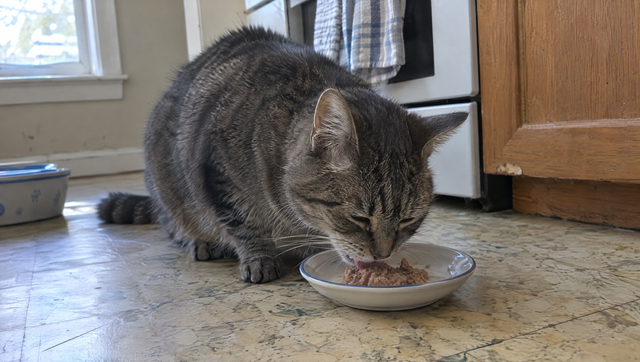
Which format suits a cat?
Cats taste the world differently from us. A 2005 study in PLoS Genetics found that cats lack a working sweet taste receptor and may be unable to detect sugar. They respond to salty, sour and bitter tastes and to amino acids.
Flavor base matters too. In a 2023 Journal of the American Veterinary Medical Association study of 46 healthy cats, as summarized by the AAFP, oil-based flavors were rejected in 60% of samples and water-based flavors in 85%.
Sweet water-based flavors did worst of all, and owners were not good at predicting which flavors their cats would accept. Cornell adds that dry food may be less palatable to cats than moist food.
That makes a savory, moist format a reasonable first try for many cats. One option in that format is the Squeeze Vita Stick Variety Pouch: seven creamy 15 g sticks made with chicken, salmon, tuna, pollack and lobster, plus fruits and vegetables.
Its label says each stick can be squeezed out by hand, into a small bowl, or over food, for cats and dogs 12 months and older. Our guide to choosing a lickable cat supplement goes deeper on that format.
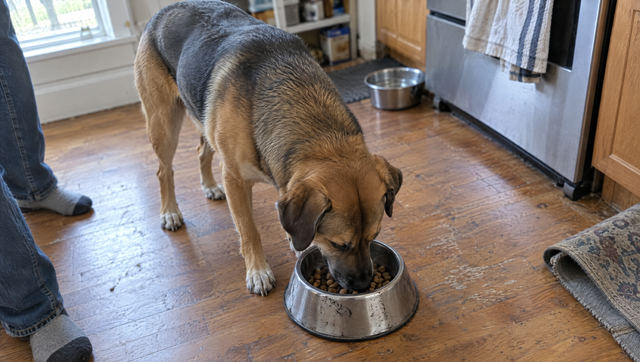
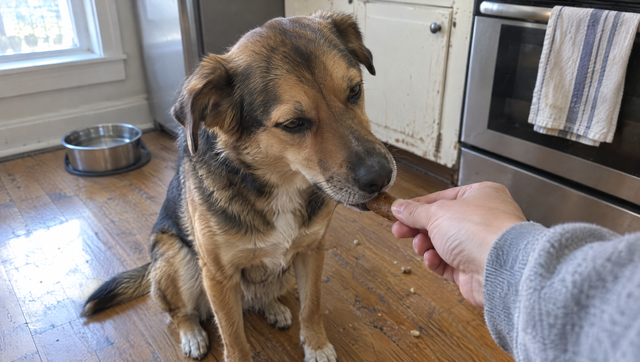
Which format suits a dog?
For dogs, the ASPCA data above is the main caution with chews. A flavored chew that's easy to give is also easy to eat by the container, so store the pack where your dog can't reach it.
Whatever the format, the calories count. The Merck Veterinary Manual says the total daily amount of treats should be under 10% of a pet's total calorie intake, and most are not complete and balanced. Tasty supplements belong inside that allowance.
A powder can work well for a dog that reliably finishes its bowl. Merck's caution still applies: a pet that leaves food behind leaves part of the dose behind too.
If your dog also takes tablets, our guide on how to give a dog a pill covers the hands-on side.
What should the label tell me?
Whatever the format, read the label before the flavor. AAFCO's pet food label rules give you a checklist:
- the species it's for, which should be clearly shown on the front panel
- the quantity, by weight, liquid measure or count
- the amounts of specific nutrients. AAFCO says vitamin or mineral supplements must list the vitamins or minerals they provide
- an ingredient list, in descending order by weight
- the name and address of the manufacturer or distributor
AAFCO says snacks, treats and supplements are exempt from the "complete and balanced" statement. A snack-type product not labeled as a snack or treat carries the line "This product is intended for intermittent or supplementary feeding only."
The FDA explains how these products are regulated. Products sold as dietary supplements for animals don't fall under the human supplement law. FDA treats them as either food or animal drugs, depending on their ingredients and intended use.
You may also see a yellow NASC Quality Seal. NASC, the National Animal Supplement Council, is an industry membership organization. It says companies must pass a third-party audit and keep meeting its quality requirements to display the seal, which cannot be bought.
What are the red flags?
- Disease claims. The FDA says that if a product's intended use is to treat or prevent a disease, it is a drug. AAFCO warns that unapproved drug claims, stated or implied, misbrand animal feed products.
- No name or address on the pack, since AAFCO lists the guarantor's name and address as required.
- A product made for people. AAFCO says animal feed supplements are not like human dietary supplements, and Merck lists xylitol among possibly toxic ingredients in human supplements.
- No species on the front, or one that doesn't match your pet.
Call your vet promptly if:
- your pet has eaten more than the labeled amount, or a whole pack of chews. Your vet or the ASPCA Animal Poison Control Center can advise
- your pet takes any medicine or eats a prescribed diet, before adding anything
- your pet starts leaving meals that have a powder mixed in
- you're unsure of the dose. AAFCO advises using the dose your vet gives and following the label directions
Questions pet parents ask
Are chews better than powders?
Neither is better across the board. Chews are easy to give but need locking away, per the ASPCA. Powders depend on your pet finishing the food, per Merck.
Do supplement calories count toward my pet's daily food?
Yes. Merck's guidance is that treats should stay under 10% of total daily calories, and a flavored chew or stick is part of that total.
Is the NASC seal a government approval?
No. NASC is an industry organization, and its seal reflects its own audit. The FDA says animal food generally does not need pre-market review, while animal drugs must be approved before sale.
Can I use my own supplement for my pet?
Ask your vet first. AAFCO warns that human supplements should not be used for drug purposes in pets, and some contain ingredients like xylitol that Merck flags as possibly toxic.
Sources
- AAFCO: Supplements
- AAFCO: Reading Labels
- FDA Center for Veterinary Medicine: FDA's Regulation of Pet Food
- FDA: Medication Errors Happen to Pets, Too
- Merck Veterinary Manual: How Drugs Are Given to Animals
- Merck Veterinary Manual: Feeding Practices in Small Animals
- Merck Veterinary Manual: Toxicoses in Animals From Human Multivitamins and Supplements
- Cornell Feline Health Center: Feeding Your Cat
- ASPCA: The Top 10 Toxins of 2025
- Li X, et al. Pseudogenization of a Sweet-Receptor Gene Accounts for Cats' Indifference toward Sugar. PLoS Genetics, 2005
- AAFP: February 2023 Timely Topics, summarizing Nichelason AE, et al. Journal of the American Veterinary Medical Association, 2023
- National Animal Supplement Council (NASC)
This article is for general information and is not veterinary advice. Talk to your vet about your own pet — they know the animal in front of them.
Try a Little of Everything First
The Trial Box has a Variety Pouch, two Total Balance Jumbo sticks and two Berry Good Milks. One box, $22.