Cats
 Dogs
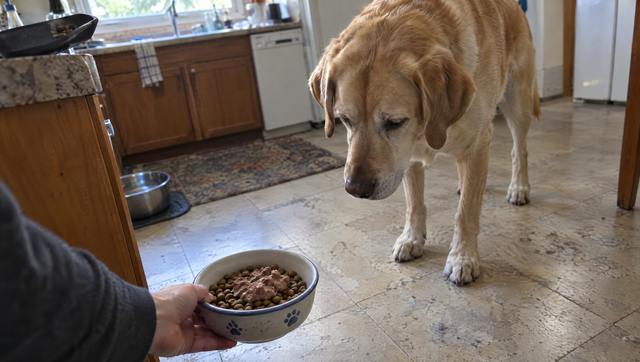
What Should a Senior Dog Eat?
There's no official standard for senior dog food. What vets say older dogs need: fewer calories, more fiber, quality protein and a food matched to body condition.


There's no official recipe for senior dog food. The 2023 AAHA Senior Care Guidelines note that AAFCO has no senior nutrition guidelines, and say senior dogs need fewer calories per bite and more fiber to keep a healthy body condition.
A modest step up in protein amount and quality may help offset the muscle older dogs tend to lose. The right food is complete and balanced, matched to your dog's body condition, and chosen with your vet.
That means the word "senior" on a bag tells you less than you'd hope. Here's what the veterinary research says to look at instead.
When is a dog a senior?
Later than a birthday can tell you. AAHA's guidelines say there is no specific age for senior status, because aging varies by species and breed. AAHA's canine guidelines define senior as "the last 25% of estimated lifespan through end of life."
So a giant breed and a small terrier can reach that stage years apart. Your vet can estimate where your dog sits, and our guide to dog years to human years explains why size changes the math.
What makes senior dog food different?
Less than most people expect. The Merck Veterinary Manual notes that neither AAFCO nor the National Research Council recognizes that nutrient needs may change in healthy older dogs, though research suggests the adult years should be split into stages.
Without a standard, labels vary widely. Veterinary nutritionists at Tufts University's Cummings School compared nearly 40 senior dog foods in 2011 and found calories ranging from 246 to 408 per cup. Protein ranged from 4.8 to 13.1 g per 100 calories.
In the same Tufts survey of more than 1,300 owners, most expected senior foods to have fewer calories. Only about a third of the owners feeding a senior diet did so on a vet's advice.
The study's corresponding author, Dr. Lisa Freeman, put it plainly: not all older dogs require a senior diet, and these foods are not all the same.
The ingredient list won't settle it either. WSAVA, the World Small Animal Veterinary Association, explains that an ingredient's name doesn't tell you its nutritional quality or digestibility. What matters is that the finished food is shown to meet your dog's needs.
On a US label, that's the AAFCO statement. WSAVA says it tells you whether a food is complete and balanced for a species and life stage, or for intermittent feeding only, and whether it was proven by feeding trials or formulated to tables.
How many calories does an older dog need?
Usually fewer. AAHA's guidelines say a dog's maintenance energy needs generally fall over its lifetime, and that the ideal body condition score is 4.5 to 5 out of 9.
A lifelong study adds a striking result. In a study of 48 Labrador Retrievers published in the Journal of the American Veterinary Medical Association, one dog in each pair ate 25% less than its pair-mate from 8 weeks of age.
The dogs fed less had a significantly longer median life span. The study was run by a pet food company's research team, and it fed less from puppyhood, so it can't tell you how much to cut for your own dog.
Older dogs don't all move the same way. AAHA says dogs tend to lose lean body mass and gain fat as seniors, then lose weight overall in advanced age. Merck notes that some dogs begin old age considerably overweight, while others lose condition.
That's why the bag's feeding chart is only a starting point. Ask your vet to score your dog's body and muscle condition at each visit and adjust the amount from there.
Do older dogs need more or less protein?
Possibly a little more. Merck explains that older dogs may not use dietary protein as efficiently as younger dogs, so they may actually need more of it to maintain protein reserves.
AAHA's guidelines describe the change as mild increases in protein content and quality, to make up for lost lean body mass. Quality here means digestibility. Merck grades protein digestibility above 93% as very high, 86 to 93% as high and below 80% as low.
The guidelines add that digestibility may be less of an issue for dogs than for cats. One study cited by AAHA found that adding moisture to food made nutrients more digestible for senior dogs.
That's one reason moisture comes up in our comparison of wet or dry dog food.
What should I watch for as my dog ages?
Changes in eating are often the first clue. AAHA recommends a medical workup for senior pets once or twice a year, and lists signs of chronic disease that owners can spot at home.
Call your vet promptly if your senior dog:
- eats less, or stops eating
- loses weight or muscle over time
- drinks noticeably more or less than usual
- seems more tired week by week, which AAHA calls progressive lethargy
- moves differently or less easily, which AAHA calls mobility alterations
- has a wound that won't heal
- changes in behavior in a way you can't explain
Merck recommends periodic checks of weight and body condition for older dogs. It notes that chronic degenerative organ disease becomes more common with age, and that early diagnosis allows more effective nutritional management.
Does a senior dog need supplements or toppers?
AAFCO says healthy dogs fed a complete and balanced diet for their life stage generally don't need supplements. It warns that adding them risks going over upper limits, and names vitamin D as having a fairly small gap between needed and toxic, particularly for dogs.
Our article on whether dogs need vitamins goes further into that question. Whatever you add, keep it small. WSAVA counts supplements, chews and snacks together and says they should stay under 10% of a dog's daily calories.
Tell your vet about anything you give, too. AAHA's guidelines ask vets to record every supplement, cream or oil a senior pet receives, because some combine badly with common medications.
What a topper looks like on the label
If your vet is happy for you to add something, read the label against the 10% budget. One example is Choolip's Total Balance stick: a lickable purée of tuna, cod, salmon and lobster for cats and dogs from 12 months old.
Each 15 g stick provides 12.4 calories, and the label sets amounts for seven nutrients: vitamins A, E, B2 and B3, iron, zinc and a heat-treated postbiotic.
A postbiotic isn't live bacteria: the 2021 ISAPP consensus defines it by inanimate (non-living) microorganisms or their components. The label says the stick is for intermittent or supplemental feeding only, so it goes over the regular food rather than replacing it.
Questions senior dog parents ask
Should I switch my older dog to senior food?
Not automatically. In the Tufts study, Dr. Freeman said not all older dogs require a senior diet, and that senior foods vary so much that the choice is best made with your vet.
Do senior dogs need less protein?
Healthy ones usually don't. AAHA suggests mild increases in protein content and quality for senior dogs, and Merck says older dogs may need more protein than younger ones.
What age is a senior dog?
AAHA defines it as the last 25% of a dog's estimated lifespan, so the age depends on breed and size.
Is wet food better for senior dogs?
One study cited by AAHA found that added moisture increased nutrient digestibility in senior dogs. Wet or dry, the food should still be complete and balanced.
How many extras can an older dog have?
WSAVA says snacks, chews and supplements together should stay under 10% of daily calories.
Sources
- Quimby J, et al. 2023 AAHA Senior Care Guidelines for Dogs and Cats. Journal of the American Animal Hospital Association
- Merck Veterinary Manual: Nutritional Requirements of Small Animals
- Merck Veterinary Manual: Feeding Practices in Small Animals
- Kealy RD, et al. Effects of diet restriction on life span and age-related changes in dogs. JAVMA, 2002
- Tufts University: Wide Variety in Nutritional Content Found in Senior Dog Foods (on Hutchinson D, Freeman LM, et al., 2011)
- AAFCO: Supplements
- WSAVA Global Nutrition Committee: Feeding Treats to Your Dog
- WSAVA Global Nutrition Committee: Frequently Asked Questions and Myths
- Salminen S, et al. The ISAPP consensus statement on the definition and scope of postbiotics. Nature Reviews Gastroenterology & Hepatology, 2021
This article is for general information and is not veterinary advice. Talk to your vet about your own dog — they know the animal in front of them.
Try a Little of Everything First
The Trial Box has a Variety Pouch, two Total Balance Jumbo sticks and two Berry Good Milks. One box, $22.