Cats
 Dogs
Are Cats Lactose Intolerant?
Many adult cats are lactose intolerant. Why the enzyme fades after weaning, what milk can do, a lactose chart for common dairy foods, and what to offer instead.


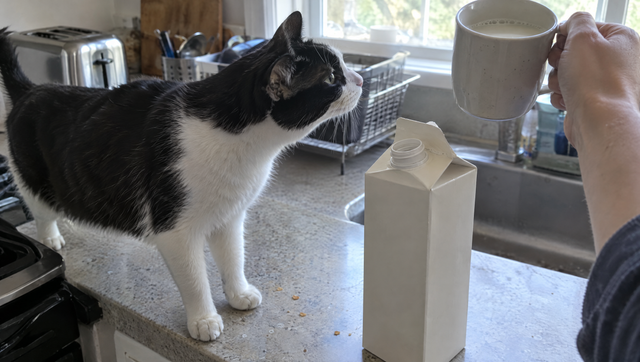
Yes, many cats are. Are cats lactose intolerant from birth? No: kittens digest their mother's milk well. The Merck Veterinary Manual explains that a cat's lactase activity declines after weaning, and that cats may become lactose intolerant.
Cornell's Feline Health Center says many cats are lactose-intolerant, and the ASPCA warns that milk and milk-based products can cause cats to vomit or have diarrhea. Water is the drink cats need.
Are cats lactose intolerant, or just some of them?
Lactose is the natural sugar in milk. To absorb it, the gut first has to split it with an enzyme called lactase.
The ASPCA's cat nutrition guide says cats do not possess significant amounts of lactase. Merck's veterinary manual describes the same thing in more technical terms: a relative lactase deficiency in cats, with lactase activity that declines after weaning.
The wording matters. Cornell says "many cats," and Merck says cats "may" become lactose intolerant. Neither source says every cat reacts the same way, and there is no simple home test that tells you which group your cat is in.
Merck adds a second route. In both cats and dogs, lactose intolerance can also develop after general damage to the lining of the small intestine, which is why it advises against feeding dairy to animals with diarrhea.
Why can kittens drink milk when adult cats struggle?
A nursing kitten makes the lactase it needs. The ASPCA notes that newborn kittens get complete nutrition from their mother's milk for the first four weeks of life.
That enzyme fades as the kitten grows. A study of carbohydrate digestion in cats, published in the British Journal of Nutrition in 1977, found that intestinal lactase activity decreased with age in kittens between 71 and 106 days old.
Here is the surprising part. In that same study, adding lactose to the kittens' diet did not significantly change their lactase activity. Giving milk did not keep the enzyme from fading.
So a cat who lapped milk as a kitten can still have trouble with it later. Kittens without a mother need a kitten milk replacer, never cow's milk, which we explain in can kittens drink milk.
What happens when a lactose-intolerant cat drinks milk?
The ASPCA's cat nutrition guide puts it plainly: feeding milk and milk-based products to cats can cause them to vomit or have diarrhea.
The ASPCA's list of people foods to avoid says the same for pets in general. Because pets lack significant lactase, milk and other dairy-based products can cause diarrhea or other digestive upset.
Cornell's wording is that lactose-intolerant cats can develop gastrointestinal problems if fed dairy products. Merck's guide for cat owners says milk is not a recommended treat for cats and can upset a cat's stomach.
The 1977 study found something similar under controlled conditions. Adult cats digested most of the lactose in their diet, yet lactose still caused diarrhea in some of the cats.
Call your vet promptly if your cat:
- has diarrhea that lasts longer than a day or two along with poor appetite, low energy or vomiting. Cornell advises veterinary care as soon as possible in that case
- is a kitten with any digestive upset. Cornell notes kittens may be at higher risk while their digestive systems adjust to solid food
- has been put on a special diet by your vet. Ask before offering any extra, dairy included
How much lactose is in milk, cheese and yogurt?
Dairy foods vary a lot. These figures come from the USDA's FoodData Central, the US government's food composition database. They are per 100 grams, rounded.
| Dairy food (per 100 g) | Lactose (g) |
|---|---|
| Whole cow's milk | 4.8 |
| Plain whole-milk yogurt | 3.4 |
| Heavy whipping cream | 2.9 |
| Cottage cheese | 2.7 |
| Salted butter | 0.6 |
| Cheddar cheese | 0.2 |
By our arithmetic, cheddar carries roughly one-thirtieth of the lactose in the same weight of whole milk. Lactose is only one part of the picture, though.
Merck's guide for cat owners says dairy products of any kind, including raw milk, should not be fed to cats. A low-lactose food is still dairy, and cheese and cream are rich. We look at cheese in detail in can cats eat cheese.
Is lactose intolerance the same as a milk allergy?
No. Lactose intolerance is about the milk sugar and the missing enzyme. Food allergy involves the proteins in food, and Merck's veterinary manual notes that cats can develop an allergy to any protein in the diet.
Dairy is a common one. Merck lists beef, fish and dairy products as the most common food allergens in cats. Its cat owner guide adds that there is no reliable test other than a limited diet trial designed by your vet.
That difference matters when you read a label. "Lactose-free" tells you the milk sugar has been removed or broken down. The milk proteins are still there, so a lactose-free product is not automatically right for every cat.
We found no approved veterinary source that has evaluated lactose-free milks made for cats. If you are considering one, ask your vet first.
What should my cat drink instead of milk?
Water. Cornell says cats should have access to clean, fresh water at all times, and the ASPCA says milk should not be given to cats as a substitute for water.
Merck's guide for cat owners advises multiple bowls of fresh, clean water, cleaned daily. Food counts too: Cornell notes canned cat food has a moisture content of at least 75 percent, against 6 to 10 percent for dry food.
If your cat is a reluctant drinker, our guide on how to get a cat to drink more water covers bowls, fountains and wet food. For the full picture on dairy, see can cats drink milk.
Questions cat parents ask
Are all cats lactose intolerant?
The sources stop short of "all." Cornell says many cats are lactose-intolerant, and Merck says cats' lactase activity declines after weaning and they may become intolerant. Your cat may react more or less than another cat.
Can a lactose-intolerant cat have a little milk?
The veterinary sources advise against it. Cornell says milk is not generally recommended as a treat, and Merck's guide for cat owners says milk can upset a cat's stomach.
Why does my cat love milk if it is bad for her?
The sources we used do not explain the appeal. Liking a food and digesting it well are separate things, and Merck still lists milk among foods not recommended for cats.
Is goat's milk easier for cats?
The sources we used give no reason to think so. A Journal of Feline Medicine and Surgery review on orphaned kittens found goat's milk has no nutritional benefits compared with cow's milk.
Do kittens become lactose intolerant at weaning?
Merck says lactase activity declines after weaning. The ASPCA says weaning usually starts around four weeks and is completed by eight to ten weeks.
Sources
- Merck Veterinary Manual: Malabsorption Syndromes in Small Animals
- Merck Veterinary Manual (Cat Owners): Proper Nutrition for Cats
- Merck Veterinary Manual: Nutrition in Disease Management in Small Animals
- Merck Veterinary Manual (Cat Owners): Allergies of Cats
- Cornell Feline Health Center: Feeding Your Cat
- Cornell Feline Health Center: Diarrhea
- ASPCA: Cat Nutrition Tips
- ASPCA Animal Poison Control: People Foods to Avoid Feeding Your Pets
- Morris JG, Trudell J, Pencovic T. Carbohydrate digestion by the domestic cat (Felis catus). British Journal of Nutrition, 1977
- Little S. Playing Mum: Successful management of orphaned kittens. Journal of Feline Medicine and Surgery, 2013
- USDA FoodData Central (lactose values: whole milk 746782, plain whole-milk yogurt 2259793, heavy cream 170859, cottage cheese 172179, salted butter 790508, cheddar 328637)
This article is for general information and is not veterinary advice. Talk to your vet about your own cat — they know the animal in front of them.
Choolip products are food supplements, not medicine. They are not intended to diagnose or manage any medical condition. If your cat has been diagnosed with a condition, their diet should be set by your vet.
Try a Little of Everything First
The Trial Box has a Variety Pouch, a Jumbo stick and two Berry Good Milks. Subscribe & Save, $22.00 a box.