Cats
 Dogs
Cat Zoomies: Why Cats Suddenly Race Around
Why cats suddenly sprint around the house, why it happens at dawn and dusk, how play gives the hunting drive a better outlet, and when a change is worth a vet visit.


Cat zoomies are sudden bursts of racing, leaping and pouncing. No veterinary source we found studies them by name. The AAFP and ISFM guidelines on feline environmental needs describe a strong instinct to stalk, chase and pounce, and that hunting drive is the likeliest explanation.
The Merck Veterinary Manual describes cats as crepuscular, most active around dawn and dusk, which may be why the bursts often come early and late. Here's what the research shows, how the guidelines suggest channeling that energy, and when to talk to your vet.
What are cat zoomies?
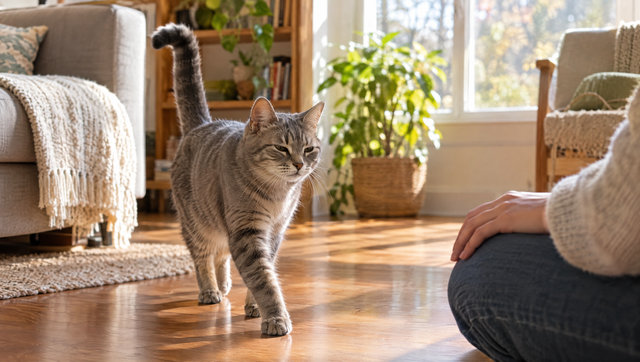
"Zoomies" is an informal name for a short, intense spell of running and pouncing, often with no obvious trigger. The cat goes from calm to full speed, then settles again.
Research shows how still cats are the rest of the time. A 2024 study that tracked 28 pet cats with collar sensors found they spent about 86% of their time lying, sitting or standing.
In the same study, walking and trotting took up only around 2 to 4% of the day.
Why do cats get the zoomies?
There is no study of zoomies themselves, but veterinary guidelines describe several things that may contribute.
A hunter's energy
The AAFP and ISFM guidelines describe a strong instinct to carry out a predatory sequence: locating, stalking, chasing, pouncing, killing and eating prey. They note that predatory behavior occurs even in well-fed cats.
As solitary hunters, cats may eat 10 to 20 small prey a day, according to the same guidelines, and it has been suggested that up to half of their hunting attempts fail.
The guidelines say that for cats able to hunt, predation takes up a significant share of daily activity and calls for considerable physical activity. An indoor cat may have few outlets for that drive, and a sudden sprint may be one of them.
Built for dawn and dusk
The Merck Veterinary Manual describes cats as crepuscular, meaning most active in the twilight hours around dawn and dusk.
A 2022 study in the journal Animals tracked cats living indoors and in an outdoor enclosure. Both groups showed activity peaks around twilight. The indoor cats peaked before sunrise, around 5 a.m., and again in the late evening after sunset.
The same researchers found the cats were more active when people were around.
Age plays a part
Merck's manual says kitten object play begins at about 6 to 8 weeks and peaks at around 18 weeks. It describes that play as simulating the predatory sequence: stalking, chasing, pawing, pouncing and biting.
In the 2024 sensor study, the youngest group of cats was more active than cats in their prime, and time spent active fell as cats got older.
What about zoomies after the litter box?
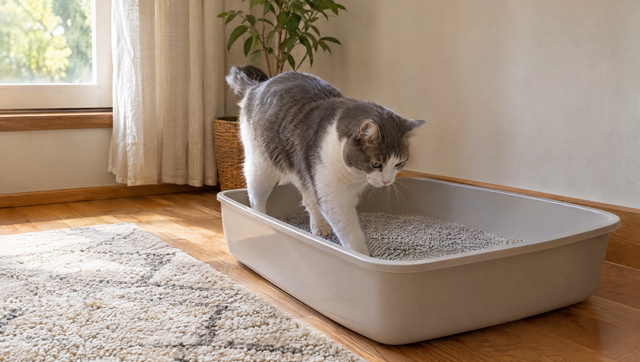
Some cats sprint off the moment they finish in the litter box. No veterinary source we found has studied why, so we can't give a reason.
If litter box habits or behavior around the box change, ask your vet whether it needs a closer look.
Are cat zoomies normal?
No veterinary source we found addresses zoomies directly. The AAFP and ISFM guidelines treat stalking, chasing and pouncing as part of a cat's normal predatory behavior, and the Merck manual describes the dawn-and-dusk activity pattern.
If you're unsure whether your cat's bursts are typical, ask your vet. Our guide to cat body language covers the body signals that go with play and with fear.
Merck's manual notes that cats sleep about 40% of the day and rest another 22%. Our guide to how much do cats sleep covers what a normal day of rest looks like.
How can I give my cat a better outlet?
The AAFP and ISFM guidelines recommend letting a cat express as many parts of the predatory sequence as possible through play and feeding. They suggest:
- moving a wand toy so it mimics flying prey, swooping through the air, or ground prey, moving in straight lines swiftly away from the cat
- letting the cat catch the toy to simulate a capture, then rewarding with a treat after play
- using toys on a rotating basis to prevent habituation and boredom
- hiding food in several places, scattering or tossing kibble for the cat to chase, or using puzzle feeders
Merck's manual adds that owners should find a number of toys that interest the cat and play with several until its interest wanes. It also suggests outlets to climb, perch on and scratch.
Merck's manual says cats prefer around 13 small meals a day, and that hunting and feeding needs may be better met with small portions through the day and food placed in toys.
If your home is short on vertical space, our guide to does my cat need a cat tree covers what to look for.
Safety rules from the guidelines
- The AAFP and ISFM advise avoiding hands and feet in any kind of play, to prevent injury to the cat or the person.
- They advise putting away toys with string, or other parts a cat could swallow, after play.
When are zoomies a reason to call the vet?
Cornell's Feline Health Center notes that older cats tend to be less active and playful, may sleep more, gain or lose weight, and have trouble reaching their favorite places.
Cornell also warns against chalking up health or behavior changes to old age, because such changes can be signs of common diseases or dental problems that should be addressed by your veterinarian.
Talk to your vet if your cat:
- shows a change in activity or behavior, sudden or gradual
- is gaining or losing weight
- has trouble reaching favorite places
Ask your vet whether a note of when the bursts happen, and how often, would help.
Questions new cat parents ask
Why does my cat get zoomies at night?
Merck describes cats as crepuscular, most active around dawn and dusk. Indoor cats in the 2022 Animals study peaked before sunrise and after sunset.
Do cats grow out of zoomies?
Merck puts the peak of object play at about 18 weeks, and the 2024 sensor study found activity fell as cats aged. No study we found tracks zoomies across a cat's life.
Should I stop my cat's zoomies?
The AAFP and ISFM guidelines focus on giving the hunting drive outlets through play and feeding, not stopping it. Ask your vet if the bursts worry you.
Does a full stomach stop the urge to hunt?
The AAFP and ISFM guidelines note that predatory behavior occurs even in well-fed cats, which is why they recommend play as well as food.
Sources
- Ellis SLH, Rodan I, Carney HC, et al. AAFP and ISFM Feline Environmental Needs Guidelines. Journal of Feline Medicine and Surgery, 2013
- Merck Veterinary Manual: Social Behavior of Cats
- Parker M, et al. Comparison of Locomotor and Feeding Rhythms between Indoor and Outdoor Cats Living in Captivity. Animals, 2022
- Smit M, Corner-Thomas RA, Draganova I, Andrews CJ, Thomas DG. How Lazy Are Pet Cats Really? Using Machine Learning and Accelerometry to Get a Glimpse into the Behaviour of Privately Owned Cats in Different Households. Sensors, 2024
- Cornell Feline Health Center: Loving Care for Older Cats
This article is for general information and is not veterinary advice. Talk to your vet about your own cat — they know the animal in front of them.
Try a Little of Everything First
The Trial Box has a Variety Pouch, two Total Balance Jumbo sticks and two Berry Good Milks. One box, $22.