Cats
 Dogs
What Is a Lick Mat For?
What a lick mat does, what the research says about it, what to spread on it and what to keep off it, and how to clean it safely.


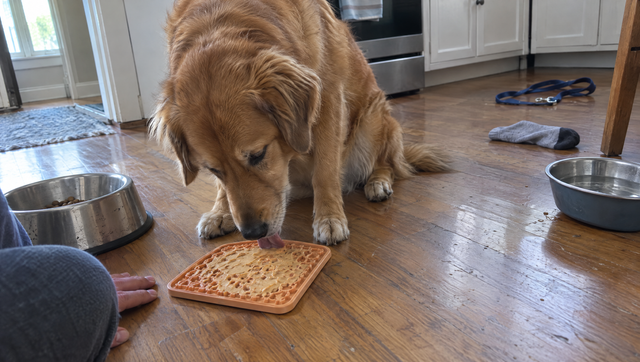
A dog lick mat is a flat rubber or silicone mat covered in grooves and bumps. You spread something soft on it, and your dog licks it clean, slowly.
It makes a small snack last longer, slows a fast eater, and keeps a dog busy during baths, nail trims and vet visits.
The research on lick mats themselves is thin. The idea behind them is well supported, though, and the safety basics are simple. Here's what a lick mat does, what to put on it, and how to keep it clean.
What does a lick mat actually do?
A bowl lets a dog empty a meal in seconds. A lick mat turns the same food into a slow job, because every bit has to be worked out of the grooves with the tongue.
The ASPCA describes food puzzles as a way to slow down a dog's eating and provide mental stimulation. A lick mat is about the simplest food puzzle there is. There's nothing to open, roll or knock over.
Veterinary teams use the same idea. The AAHA behavior management guidelines describe spreading soft food on a surface during handling. Spreadable food, they note, can be used for distraction and redirection, and to reduce fear and stress.
That's why you may see a vet nurse holding a spoon of something soft at the exam table. AAHA's own examples include cream cheese, spray cheese, pâté and some canned foods. A dog busy licking has something else to focus on during a nail trim.
What does the research say about lick mats?
Honestly, not much yet about lick mats on their own. Studies tend to look at food enrichment as a whole, which takes in stuffed toys, puzzle feeders, chews and mats together.
The largest survey so far was published in Veterinary Record by researchers at the University of Liverpool. It asked 1,750 dog owners how they used enrichment at mealtimes. Its title sums up the starting point: "Bowls are boring."
Owners most often used these feeders as a treat, to deliver meals and to keep their dogs busy. Mental stimulation was a benefit many of them described.
The authors are careful about what that means. A survey shows what owners noticed, and it cannot prove cause and effect. They call for proper experiments to test it.
So a lick mat is a reasonable, low-risk way to make food last longer and give your dog something to focus on. Whether it changes a dog's mood over weeks and months is still an open question.
What can I put on a lick mat?
Start with food your dog already eats well. Their usual wet food works, or a little of their regular kibble softened with warm water and mashed.
The ASPCA suggests filling food puzzles with plain yogurt, peanut butter or a dog's own meal. Use a thin layer. A smear pressed into the grooves lasts far longer than a thick mound on top.
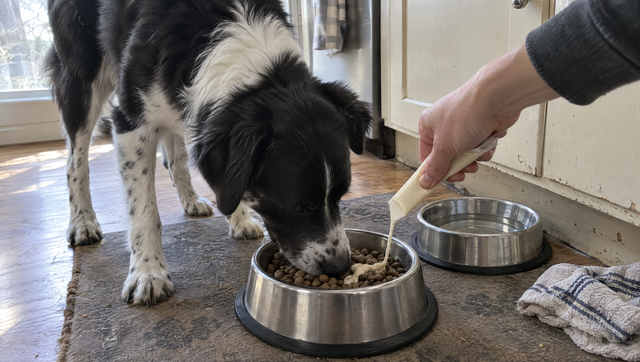
A lickable food made for pets is another option. Squeeze Vita Stick Variety Pouch has seven creamy recipes made with real chicken, salmon, tuna, pollack and lobster plus fruits and vegetables. Its soft texture spreads straight from the stick into the grooves.
Many of the same rules apply to dog food toppers: small amounts, simple ingredients, and nothing that replaces a complete meal.
Keep these off the mat
Some of the most spreadable foods in a kitchen are also the riskiest.
- Peanut butter with xylitol. The FDA lists some peanut and nut butters among products that can contain this sweetener. In dogs it can cause a sudden, dangerous drop in blood sugar within 10 to 60 minutes. Check the label, especially on anything sold as sugar-free or low sugar.
- Anything made with onion, garlic or chives.
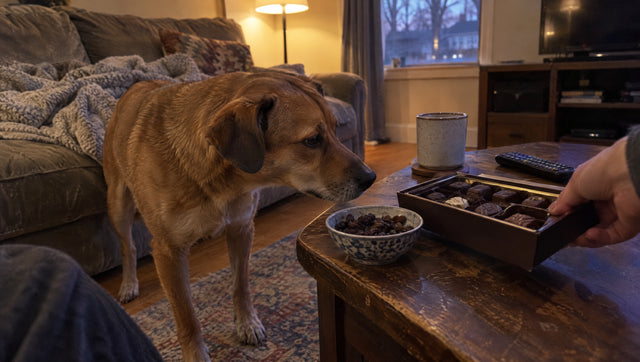
- Grapes, raisins and chocolate.
- Large amounts of dairy. The ASPCA notes that pets don't make much lactase, the enzyme that breaks down milk sugar, so dairy can cause digestive upset. Keep yogurt to a thin smear.
All of these appear on the ASPCA's list of people foods to avoid feeding pets, which is worth a look before you raid the fridge.
How much food should go on it?
Whatever goes on the mat counts as food. The Merck Veterinary Manual says the total daily amount of treats should stay under 10% of a dog's total calories.
The simplest way to stay inside that limit is to use part of your dog's regular meal. Take a spoonful of wet food out of dinner and spread it on the mat instead. Your dog gets the activity with no extra food at all.
Freezing helps the mat last. The ASPCA suggests freezing a stuffed food toy so getting the food out takes longer, and a lick mat works the same way. Spread it, lay it flat in the freezer, then hand it over.
How do I keep a lick mat clean?
The grooves that hold food for your dog also hold it for bacteria. Clean a lick mat the way you'd clean a food bowl, because that's what it is.
The FDA's pet food handling tips are short. Wash bowls and utensils with soap and hot water after each use. Wash your hands before and after handling pet food. Refrigerate or throw out leftover canned or pouched food promptly.
Here's the surprising part. In a North Carolina State University study published in PLOS ONE, only 4.7% of 417 dog owners were aware those tips existed.
When owners in the same study followed the tips for a week, bacteria counts on their dogs' dishes dropped. Washing in hot water above 160°F worked better than cold or lukewarm water.
A small brush reaches into grooves better than a sponge. Let the mat dry fully between uses, and check the maker's instructions before putting it in the dishwasher.
Is it safe to leave my dog alone with a lick mat?
Stay nearby, at least until you know how your dog uses it. Some dogs lick politely. Others chew the edges, and torn-off pieces of rubber or silicone aren't food.
The ASPCA's advice for any enrichment item is close, active supervision. If your dog tries to swallow part of it, take it away. Replace a mat once it's torn or badly chewed.
Food can also change how some dogs behave. AAHA's guidelines caution against using spreadable foods with dogs that become reactive or aggressive around food. In a home with more than one dog, give each dog their own mat in their own space.
Puppies can use a lick mat with the same rules.
Stick one to the side of the tub when you learn how to bathe a puppy, or bring one out for short supervised sessions while you work on how to crate train a puppy. Take it away once the food is gone.
Call your vet promptly if your dog:
- swallowed a piece of the mat
- may have eaten anything containing xylitol. The FDA advises calling your vet, an emergency clinic or an animal poison control center right away. The ASPCA Animal Poison Control Center is at (888) 426-4435, and a fee may apply.
- seems weak, wobbly or collapses after eating something from the mat
- starts guarding food or snapping when you come near the mat
Questions new dog parents ask
Are lick mats good for dogs?
For most dogs they're a simple, low-risk way to slow eating and add some mental stimulation, which is how the ASPCA describes food puzzles. Research on lick mats specifically is still limited.
Can I put peanut butter on a lick mat?
Yes, if the label shows no xylitol. Spread a thin layer and count it toward your dog's daily extras.
How do you clean a lick mat?
With soap and hot water after every use, the same way the FDA recommends for food bowls. A small brush gets into the grooves.
Can puppies use lick mats?
Yes, with supervision and food that suits a puppy. Choose a sturdy mat and pick it up when it's empty.
Can cats use a lick mat?
Yes. The AAFP recommends frequent small meals and puzzle feeders for cats, to suit their natural foraging. A thin layer of wet food on a lick mat is a simple version of the same idea.
Sources
- Hammerle M et al. 2015 AAHA Canine and Feline Behavior Management Guidelines. JAAHA, 2015
- Heys M, Lloyd I, Westgarth C. 'Bowls are boring': Investigating enrichment feeding for pet dogs and the perceived benefits and challenges. Veterinary Record, 2024
- Luisana E et al. Survey evaluation of dog owners' feeding practices and dog bowls' hygiene assessment in domestic settings. PLOS ONE, 2022
- ASPCA: Canine DIY Enrichment
- ASPCA: At-Home Tips for Keeping Your Pets Busy and Engaged
- ASPCA: People Foods to Avoid Feeding Your Pets
- ASPCA: Animal Poison Control
- FDA: Paws Off Xylitol; It's Dangerous for Dogs
- FDA: Tips for Safe Handling of Pet Food and Treats
- Merck Veterinary Manual: Feeding Practices in Small Animals
- AAFP: How to Feed a Cat Consensus Statement
This article is for general information and is not veterinary advice. Talk to your vet about your own dog — they know the animal in front of them.
Try a Little of Everything First
The Trial Box has a Variety Pouch, a Jumbo stick and two Berry Good Milks. Subscribe & Save, $22.00 a box.