Cats
 Dogs
When Can Kittens Leave Their Mom?
Most vet guidance says kittens should stay with their mom until at least 8 weeks. What each authority recommends, what kittens learn in those weeks, and what to ask before adopting.


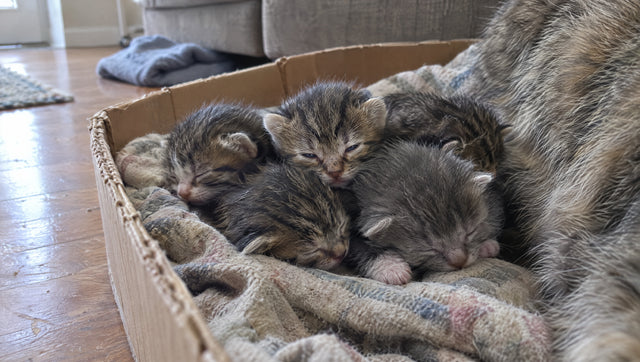
When can kittens leave their mom? The American Association of Feline Practitioners (AAFP) says a kitten is more likely to have good social behavior if it stays with its mother and siblings until at least 8 weeks. Removal before 6 weeks is not desirable.
Some evidence points later still. A 2017 survey of 5,726 cats in Scientific Reports linked separation before 8 weeks to a higher risk of aggression. Below is what each authority says, and what those weeks with mom are for.
When can kittens leave their mom, according to vets?
The guidance clusters around 8 weeks, with a few sources a little earlier or later. Here's how they line up.
| Source | What it says |
|---|---|
| AAFP Feline Behavior Guidelines | Better social behavior if left with mother and siblings until at least 8 weeks; removal before 6 weeks is not desirable |
| Merck Veterinary Manual (pet owner edition) | Kittens can generally leave mother and littermates once weaned, beginning at 6 to 7 weeks |
| ASPCA | Weaning is usually completed at 8 to 10 weeks; most mother cats nurse until about 8 weeks |
| Little's review, Journal of Feline Medicine and Surgery | Weaning is usually completed by 6 to 9 weeks |
| RSPCA and AVMA, as cited in the 2017 study | RSPCA: minimum of 8 weeks. AVMA: 7 to 9 weeks is the ideal time to move to a new home |
| Humane Society of the United States, as cited in the 2017 study | 12 weeks, the age the study used as its cutoff for early separation |
| Ahola and colleagues, Scientific Reports, 2017 | The authors suggest pushing the recommended age to 14 weeks |
The honest summary: 8 weeks is the earliest age most of these sources are comfortable with. A kitten who stays a few weeks longer with a healthy mother and littermates is inside every recommendation on this list.
What do kittens learn from their mom and littermates?
Much more than how to nurse. The ASPCA explains that kittens learn to eat, use a litter box and play, among other things, by watching their mother.
It also warns that abrupt removal from the mother cat can have a negative effect on kittens' health and socialization skills. Merck adds that cats learn how to get along with other cats from their mother and littermates.
Littermates matter in their own right. The AAHA/AAFP Feline Life Stage Guidelines note that time with littermates builds special social bonds, and that play between cats peaks at around 12 weeks of age.
The AAFP's behavior guidelines put the downside plainly: kittens separated from their mothers at an early age are more likely to be suspicious and aggressive.
What happens week by week before a kitten is ready?
This timeline draws on the AAFP behavior guidelines, Little's review and the ASPCA. Every row is something a kitten usually learns or grows into while still with her family.
| Age | Milestone | Source |
|---|---|---|
| Birth to 2 weeks | Milk only; mother stimulates her to pee and poop; eyes open and walking by 14 days | AAFP |
| About 3 weeks | Can pee and poop on her own | Little |
| About 4 weeks | Weaning normally begins; a low-sided litter box can go in | ASPCA, Little |
| 3 to 8 weeks | Sensitive period for social learning; social play begins; starts using the litter box and grooming herself | AAFP |
| 5 to 6 weeks | Nibbling dry kitten food consistently | ASPCA |
| 8 to 10 weeks | Weaning usually complete; used to eating unmoistened kitten food | ASPCA |
| Around 12 weeks | Play with other cats peaks | AAHA/AAFP |
Kittens vary, so treat each row as a range. If you want to see how the earliest weeks unfold, our guide on when do kittens open their eyes covers the first month in detail.
What does the research say about leaving too early?
The largest study is from the University of Helsinki. Researchers surveyed the owners of 5,726 home-living cats from 40 breeds, asking at what age each cat had been separated from its mother.
Cats separated before 8 weeks had a higher risk of aggression, but not of fearful behavior. Cats separated after 14 weeks were less likely to show aggression toward strangers than early-separated cats.
They were also less likely to groom themselves excessively than cats separated at 12 weeks. The authors called later separation a simple and inexpensive way to improve the welfare of millions of cats.
The study has limits, and the authors list them. The answers came from owners, the sample was made up of volunteers, and because the study was a survey rather than an experiment, they write that they cannot conclude early separation is the cause.
Why does the socialization window matter for timing?
The age a kitten leaves home overlaps a period that shapes how she'll feel about people for life. The AAHA/AAFP guidelines describe a sensitive window that begins as early as 2 to 3 weeks and may be closing by 9 to 10 weeks.
A position statement from the Feline Veterinary Medical Association puts it at roughly 2 to 9 weeks. Merck adds that kittens usually need human contact before they're 10 to 12 weeks old to become pets that are used to people.
Here's a striking detail. The AAFP behavior guidelines cite research where kittens handled for as little as 5 minutes a day, from birth to 7 weeks, were quicker to approach people and to play with toys.
Cats not handled until 14 weeks were more fearful and aggressive toward people. So whoever has the kitten during weeks 3 to 9, the breeder, foster or shelter, matters as much as the date she goes home.
The AAHA/AAFP guidelines suggest 30 to 60 minutes a day of pleasant time with people. That's a fair question to ask anyone you adopt from.
What if a kitten has to leave mom early?
Sometimes there's no choice: the mother is gone, ill or not caring for the litter. The ASPCA notes that weaning for orphaned or hand-raised kittens can begin at about three weeks of age.
The AAFP warns that properly raising orphaned kittens is labor-intensive and should not be taken on lightly. Little's review sets out the method, and our kitten milk replacer guide walks through it step by step.
An early-separated kitten can still learn good social skills. The AAFP notes that kittens without enough early social experience may need extra effort to catch up, which makes gentle, daily handling and play even more important.
What should I ask before bringing a kitten home?
Use this checklist with a breeder, shelter or foster. Each question maps to one of the milestones above.
- How old is she, and is there a birth date? If not, the ASPCA's age guide suggests checking the eyes, weight, walking and teeth.
- Has she stayed with her mother and littermates? The AAFP's minimum is 8 weeks.
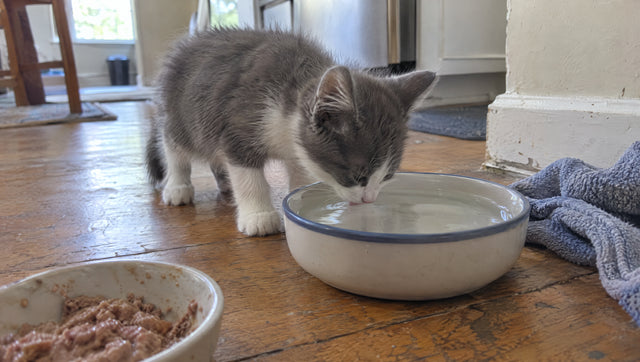
- Is she eating kitten food on her own? The ASPCA says kittens should be used to unmoistened kitten food by 8 to 10 weeks.
- Is she using a litter box? The AAFP lists litter box use among the skills of weeks 3 to 8. Our guide on how to litter train a kitten helps if she needs a refresher.
- Has she been handled by people every day? The AAHA/AAFP guidelines suggest 30 to 60 minutes a day.
- Has she seen a vet? Merck says kittens visit the vet every 3 to 4 weeks until about 6 months old for vaccines and parasite care.
Our new kitten checklist covers what to have ready at home before she arrives.
Call your vet promptly if your new kitten:
- won't eat, or isn't gaining weight. Little says poor weight gain should prompt a vet visit
- cries constantly, is restless or seems floppy, which Little says should be examined promptly
- arrived younger than 6 weeks, the age the AAFP calls too early to remove a kitten from its mother
- hasn't had a vet check yet, since Merck advises visits every 3 to 4 weeks until about 6 months
Questions new kitten parents ask
Can a kitten leave its mom at 6 weeks?
The AAFP calls removal before 6 weeks not desirable and recommends at least 8 weeks for better social behavior. Merck says kittens can generally leave once weaned, beginning at 6 to 7 weeks.
Is 8 weeks too early for a kitten to leave its mom?
No. Eight weeks is the AAFP's minimum and the RSPCA's minimum, as cited in the 2017 Scientific Reports study. That study did find benefits for cats separated later.
Is 12 weeks better than 8?
The evidence leans that way. The Humane Society of the United States uses 12 weeks, the AAHA/AAFP guidelines say cat-to-cat play peaks around 12 weeks, and the 2017 study found later separation linked to less aggression.
How can I tell if a kitten is old enough?
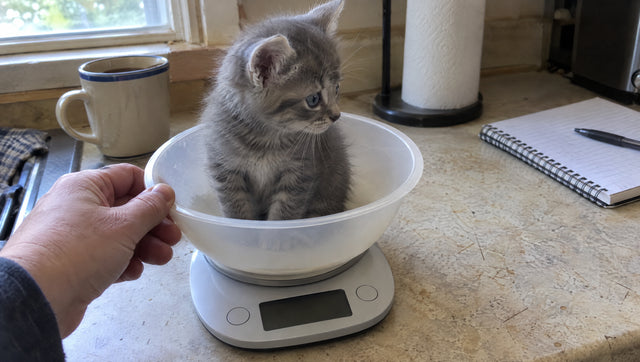
The ASPCA's guide says a kitten's weight in pounds roughly matches her age in months until about 10 weeks. By our arithmetic from that rule of thumb, a 2-pound kitten is roughly 8 weeks old. Your vet can confirm.
Sources
- American Association of Feline Practitioners: Feline Behavior Guidelines, 2004
- Ahola MK, Vapalahti K, Lohi H. Early weaning increases aggression and stereotypic behaviour in cats. Scientific Reports, 2017
- Quimby J, et al. 2021 AAHA/AAFP Feline Life Stage Guidelines. Journal of Feline Medicine and Surgery
- Merck Veterinary Manual: Kitten Care
- ASPCA: Cat Nutrition Tips
- Little S. Playing Mum: Successful management of orphaned kittens. Journal of Feline Medicine and Surgery, 2013
- Feline Veterinary Medical Association: Advocates for Proper Socialization of Kittens (position statement)
- ASPCA: How Old Is That Kitten? (ASPCApro guide)
This article is for general information and is not veterinary advice. Talk to your vet about your own cat — they know the animal in front of them.
Try a Little of Everything First
The Trial Box has a Variety Pouch, a Jumbo stick and two Berry Good Milks. Subscribe & Save, $22.00 a box.