Cats
Cats Dogs
DogsWhy Does My Dog Bark So Much?
The reasons dogs bark, how to tell them apart, why veterinary behaviorists advise against bark collars, and reward-based ways to get more quiet.


Dogs bark to talk to us: to raise an alarm, greet someone, ask for something, or say they're bored, scared or lonely. To get less of it, work out which bark you're hearing, change what sets it off, and reward quiet.
A bark collar mutes the sound but leaves the reason in place. The American Veterinary Society of Animal Behavior (AVSAB) advises against shock collars and other aversive tools, and the evidence behind that is worth knowing before you buy one.
Why does my dog bark so much?
Barking is ordinary dog language, and it starts early. AAHA's behavior guidelines note that puppies begin to bark at 4 to 5 weeks old, and that breed shapes how much they vocalize and when it starts.
So the goal is rarely silence. It's fewer barks, for better reasons.
Dr. Katherine Houpt, a veterinary behaviorist at Cornell, sorts barking into nine motives:
- excitement or play
- alert or alarm, at a stranger or a sudden noise
- guarding territory, such as the home, the yard or a regular walking route
- fear and anxiety, a "get away from me" bark
- frustration at something out of reach
- loneliness, often with pauses to listen for an answer
- demand, for food, a toy or attention
- boredom, common in high-energy dogs without enough to do
- aggression, usually loud and deep
Most dogs have two or three favorites. Each one has a different fix, which is why a single gadget rarely solves the problem.
How can I tell which kind of barking it is?
Cornell's advice is to play detective. Listen to the tone, note the time of day, and look at what your dog can see or hear when it starts.
Body language helps too. The ASPCA describes a greeting bark as loose and wiggly, with a wagging tail and sometimes a whine. An alarm bark looks stiffer, and the dog often pounces forward an inch or two with each bark.
Timing is the biggest clue for separation-related barking. The ASPCA says it happens only when the dog is left alone, often with pacing, destruction or accidents in the house.
Some barking looks like a broken record. The ASPCA describes compulsive barking as repetitive, sometimes at shadows, light flashes or mirrors, and often with pacing or spinning. That pattern needs professional help, covered below.
Do bark collars work?
Sometimes, briefly, and at a cost. That's the honest summary of the research.
In a small study in ISRN Veterinary Science, a citronella spray collar reduced problem barking in only three of seven dogs. The early drop wasn't maintained with continued use, and one dog hid and trembled until the collar came off.
The ASPCA adds a practical problem. Virtually all dogs become "collar-wise." They learn to stay quiet while wearing the collar and go back to barking once it's off.
Cornell's Dr. Houpt puts it bluntly: "Shock is nasty, ultrasound only works a few times, and citronella is okay, but it's still punishment."
Why do vets advise against them?
AVSAB's 2021 position statement recommends reward-based training for all dogs, including for problem behavior. It defines aversive methods as those that rely on force, pain, or emotional or physical discomfort, and says they should not be used.
A spray of citronella in the face fits that definition. So does a shock. The ASPCA calls anti-bark collars punishment devices and says they are not recommended as a first choice.
The concern goes beyond comfort. Studies summarized by AVSAB found that dogs trained with aversive tools showed more stress signals, such as lip licking, yawning and a lowered tail. Survey studies link them to later aggression and anxiety.
Fear barking is the clearest case. The Merck Veterinary Manual warns that techniques causing pain or fear can lead to lasting fearfulness, anxiety and aggression. A dog barking because it's scared has more reason to be scared once the bark brings a shock.
And the evidence offers no trade-off to justify the risk. AVSAB found no evidence that aversive methods work better than reward-based ones in any context.
How do I get my dog to bark less?
Match the fix to the bark. These are the approaches from the ASPCA, Cornell and AAHA, grouped by cause.
Barking at the window or the door
Take away the view. AAHA's guidelines use exactly this example: a dog barks at people outside the window, so you close the blinds or move the dog to the back of the house. Window film works for glass that has to stay clear.
For the door, the ASPCA suggests teaching your dog to go to a mat at least eight feet away when the bell rings, then rewarding them for staying there. Practice with friends playing visitors before trying it with real ones.
Background music or a TV can mask outside sounds, Cornell notes. It's a small change that helps more than you'd expect.
Barking for attention
This one is often learned by accident. The Merck manual explains that both positive attention, like play, and negative attention, like yelling, reward the barking.
So the ASPCA's advice is to give it nothing. Turn away, look at the ceiling or leave the room. The instant your dog goes quiet, ask for a sit and then give them what they wanted.
Consistency is the whole trick. The ASPCA's rule is never to reward barking at you again, because one slip teaches your dog that persistence pays.
Barking from boredom
Cornell recommends daily physical and mental exercise, short training sessions through the day, long-lasting chews and toys you rotate so they stay interesting.
A food puzzle or a dog lick mat gives a busy mouth something better to do. Cornell's list also includes proper crate training, and a well-introduced puppy crate gives a young dog a calm place to settle.
Barking from fear or frustration
Never punish fear barking. The ASPCA is firm on this unless a qualified behavior specialist advises otherwise. Keep a fearful dog away from the trigger, and ask your vet for help.
For frustration, the ASPCA suggests teaching your dog to wait, sit and stay before getting what they want, such as a walk or a game.
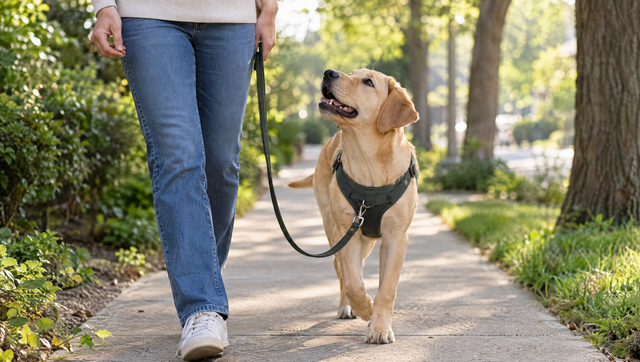
For dogs that bark at people or dogs on walks, the ASPCA suggests offering small rewards as you pass. A no pull dog harness keeps those walks calmer while you practice.
Teaching "quiet"
The ASPCA describes a simple method. When your dog barks, say "quiet" once in a calm voice. The moment the barking stops, reward with a tiny, tasty bite of food.
Then slowly stretch the pause before the reward, from 2 seconds to 5, then 10, then 20. The ASPCA says to expect several days or more of practice. Cornell suggests teaching both a "speak" and a "quiet" cue.
What if my dog only barks when I leave?
That pattern points to separation anxiety. The Merck Veterinary Manual describes it as a dog panicking when left alone, which can lead to barking, pacing and accidents in the house.
Here's a useful detail. Merck notes the signs are usually worst in the first 15 to 30 minutes after you leave. A phone or camera recording of that first half hour shows your vet exactly what's happening.
Separation anxiety is a condition your vet can diagnose and help manage, sometimes with medication alongside training. AVSAB lists it among the serious behavior problems that should always be evaluated by a vet.
A bark collar is especially poor here. The researchers behind the citronella study called any punishment of barking ethically concerning, particularly when the barking happens with the owner away.
Call your vet promptly if your dog:
- starts barking much more than usual, suddenly, with no clear trigger
- seems to be in pain, since the ASPCA notes dogs sometimes bark in response to pain
- barks only when left alone, with pacing, destruction or accidents
- barks repetitively at nothing, or spins or circles
- growls, snaps or barks aggressively at people or other dogs
Your vet can rule out a medical cause first. For fear or aggression, Cornell recommends a veterinary behaviorist. For compulsive barking, the ASPCA recommends a veterinary behaviorist or a certified applied animal behaviorist.
Questions new dog parents ask
Are bark collars cruel?
AVSAB says aversive tools, which work through pain or discomfort, should not be used in dog training. Shock and spray collars both work that way, and reward-based methods work at least as well.
Do citronella bark collars work?
Not reliably. One study found a citronella collar helped only three of seven dogs, and the effect faded with continued use. The ASPCA says most dogs learn to bark again once the collar is off.
Should I yell at my dog to stop barking?
No. The Merck manual explains that yelling is still attention, so it can reward the barking. A calm "quiet" followed by a reward for silence works better.
Are ultrasonic bark deterrents better?
Cornell's Dr. Houpt says ultrasound "only works a few times." It's still a form of punishment, so the same concerns apply.
How long does it take to teach a dog to be quiet?
The ASPCA suggests expecting several days or more for a dog to learn a "quiet" cue. Barking with a deeper cause, like fear or separation anxiety, takes longer and goes better with professional help.
Sources
- American Veterinary Society of Animal Behavior: Position Statement on Humane Dog Training, 2021
- ASPCA: Barking
- Cornell University College of Veterinary Medicine, Riney Canine Health Center: Excessive barking
- Sargisson RJ, Butler R, Elliffe D. An Evaluation of the Aboistop Citronella-Spray Collar as a Treatment for Barking of Domestic Dogs. ISRN Veterinary Science, 2011
- AAHA: 2015 Canine and Feline Behavior Management Guidelines
- Merck Veterinary Manual: Behavior Problems in Dogs (dog owners)
- Merck Veterinary Manual: Behavior Problems of Dogs
This article is for general information and is not veterinary advice. Talk to your vet about your own dog — they know the animal in front of them.
Choolip products are food supplements, not medicine. They are not intended to diagnose or manage any medical condition. If your dog has been diagnosed with a condition, their diet should be set by your vet.
Try a little of everything first.
The Trial Box has a Variety Pouch, a Jumbo stick and two Berry Good Milks. Subscribe & Save, $22.00 a box.