Cats
Cats Dogs
DogsWhen Should a Puppy Switch to Adult Food?
Small and medium dogs usually move to adult food at 9 to 12 months; large and giant breeds stay on growth food longer. How to tell, and how to make the switch.


When to switch puppy to adult food depends mostly on size. Small and medium dogs are usually ready at 9 to 12 months. Large and giant breeds need growth food for longer, often to 10 to 16 months, and some take close to 2 years.
The real signal is size rather than a birthday. The Merck Veterinary Manual recommends moving to adult food once a dog reaches about 90% of its expected adult weight.
Switch slowly, over about a week. The sections below explain why size changes the timing, and how to make the change without upsetting your puppy's stomach.
Why do puppies need puppy food in the first place?
Growing is expensive work. Merck's figures show a puppy under 4 months needs about three times its resting energy each day. A neutered adult dog needs about 1.6 times.
So a young puppy can need close to twice as many calories, for its size, as the dog it will become.
It's more than calories. Merck sets a growing puppy's minimum protein at 22.5% of the food's dry matter, against 18% for an adult. Calcium and phosphorus needs are higher during growth too.
Puppy food is built to cover all of that. Once growth winds down, those extras become more than a dog needs, which is why the switch matters at all.
When to switch puppy to adult food: a size-by-size guide
The age a dog finishes growing varies a lot with its adult size. These are the windows Merck gives:
| Expected adult size | Growth usually complete | What it means for the switch |
|---|---|---|
| Small and medium breeds | 8–12 months | Adult food around the first birthday, sometimes a little earlier |
| Large and giant breeds | 10–16 months | Stay on a large-breed growth food longer |
| The biggest giants | Up to almost 2 years | Ask your vet before switching |
Merck's guide for dog owners puts it simply: most dogs reach adulthood at 9 to 12 months, but large and giant breeds can take almost 2 years.
The American Animal Hospital Association (AAHA) adds a useful detail. Its 2019 life stage guidelines end the puppy stage when rapid growth stops, at about 6 to 9 months depending on breed and size.
Growth still continues after that, just more slowly. That's why the food switch comes a few months after your puppy stops shooting up each week.
How do I know my puppy is at 90%?
Your vet is the best judge. They can estimate your puppy's adult weight from breed and growth so far, and AAHA asks vets to weigh puppies and assess body condition at each visit.
A slowing growth curve is the clue to look for. If the scale barely moves from one month to the next, it's a good time to ask.
What's different about large and giant breed puppies?
Big puppies are the reason this question matters so much. Merck says it is important to feed a large or giant breed puppy a growth diet made specifically for large or giant breeds.
The concern is the pace of growth. Merck states that overfeeding during growth speeds it up, and that faster growth is incompatible with proper skeletal development.
Calcium is the other piece. Merck reports that diets with more than 3% calcium in their dry matter interfere with normal skeletal development in young, rapidly growing large-breed dogs, compared with diets of 1% to 3%.
That's why extra calcium on top of a complete puppy food is a bad idea for a big puppy. Leave the balance to the food, and leave changes to your vet.
The label tells you which puppies a food is for
Here's a detail most people never notice. AAFCO's model regulations require any dog food making a growth claim to say whether it covers large dogs.
The wording is fixed: "including growth of large size dogs (70 lb. or more as an adult)" or "except for growth of large size dogs." If your puppy will be big, look for the word "including."
Can my puppy just eat an "all life stages" food?
Yes, if it fits your puppy's size. AAFCO defines "All Life Stages" as covering growth, adult maintenance, and pregnancy and nursing. A food carrying that claim meets growth requirements, so there's no switch to make.
Check the same large-size line, though. An all life stages food may still say "except for growth of large size dogs."
AAFCO calls the nutritional adequacy statement perhaps the most important part of a label. It's usually a single sentence in small print, and it tells you which life stage the food is complete and balanced for.
For a fuller look at choosing that first bag, see our guide to what to feed a puppy.
How do I switch my puppy to adult food?
Slowly. AAHA advises moving dogs to a new food over seven days, because a sudden switch may cause digestive upset and put a dog off the new food.
AAHA's method is to replace 25% of the old food with the new one at first, then keep increasing the new food based on how your dog accepts it. A simple way to spread that over a week:
- Days 1–2: three-quarters puppy food, one-quarter adult food.
- Days 3–4: half and half.
- Days 5–6: one-quarter puppy food, three-quarters adult food.
- Day 7: all adult food.
The middle steps are a guide, not a rule. If your dog is hesitant, stay at a step for an extra day or two.
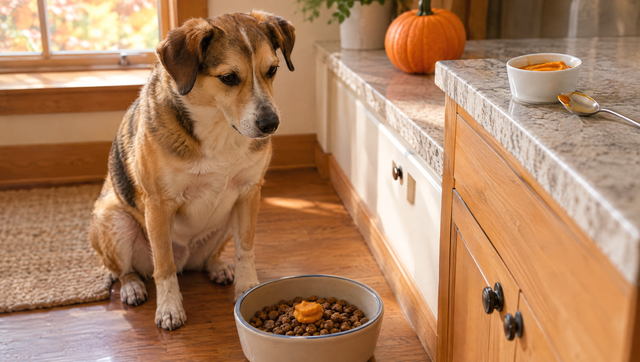
A picky eater can be won over gently. AAHA suggests a small amount of canned food as a topper, or a little low-salt chicken or beef broth. Our guides to dog food toppers and bone broth for dogs cover both.
Check the portion, too
Adult food is usually less energy-dense, so a cup of the new food may not equal a cup of the old one. Use the feeding guide on the new bag as your starting point, and measure.
Meals change at this age as well. Merck's feeding table moves puppies to two meals a day from 6 to 12 months, and adults to one or two.
Does spaying or neutering change the timing?
It often lands at the same time, and it's worth planning for. AAHA's guidelines suggest neutering large-breed males, those expected to top 45 lb, once growth is complete, usually between 9 and 15 months.
Energy needs drop afterward. Merck's figures put an intact adult dog at 1.8 times resting energy and a neutered one at 1.6 times, about a ninth less.
To make that concrete, take a 10 kg (22 lb) dog. Using Merck's formula, that's roughly 1,180 calories a day as a young puppy, about 790 after 4 months, and about 630 as a neutered adult.
Those are rough averages, and your dog's shape is the better guide. AAHA asks vets to discuss the risk of weight gain after spay or neuter for exactly this reason.
It pays off. AAHA cites a study of Labrador retrievers in which the dogs kept at their ideal weight lived, on average, 15% longer.
Call your vet promptly if your puppy:
- loses weight, or stops gaining before you'd expect
- refuses the new food for more than a day
- has an upset stomach or loose stool that doesn't settle within a day or two of slowing the switch
- seems tired, sore or reluctant to play
- is a large or giant breed and you're unsure whether growth is complete
Questions new puppy parents ask
Can I switch my puppy to adult food at 6 months?
For most puppies, that's early. Rapid growth may end around 6 to 9 months, but Merck puts the end of skeletal growth at 8 to 12 months even in small breeds. Ask your vet before switching this soon.
Is it bad to keep my dog on puppy food too long?
Puppy food carries more calories and nutrients than an adult needs. Staying on it long after growth ends means more energy than your dog needs, which makes extra weight easier to gain.
When should a large breed puppy switch to adult food?
Usually between 10 and 16 months, according to Merck, and some giant breeds take close to 2 years. Keep them on a large-breed growth food until your vet confirms growth is complete.
How old is my dog in human years when it stops being a puppy?
Dogs grow up fast in that first year. Our guide to dog years to human years explains how the math really works.
Sources
- Merck Veterinary Manual, Dog Owners: Puppy Care
- Merck Veterinary Manual: Feeding Practices in Small Animals
- Merck Veterinary Manual: Nutritional Requirements of Small Animals
- Creevy KE et al. 2019 AAHA Canine Life Stage Guidelines. Journal of the American Animal Hospital Association, 2019
- AAHA: Tips and Timelines for Transitioning Your Pet to a New Food, 2021
- AAFCO: Reading Labels
- AAFCO: Model Regulations for Pet Food and Specialty Pet Food, 2023
This article is for general information and is not veterinary advice. Talk to your vet about your own dog — they know the animal in front of them.
Try a Little of Everything First
The Trial Box has a Variety Pouch, a Jumbo stick and two Berry Good Milks. Subscribe & Save, $22.00 a box.